


Is Diabetes Genetic What Family History Really Means for Your Risk
Is Diabetes Genetic What Family History Really Means for Your Risk mob

Is Diabetes Genetic? What Family History Really Means for Your Risk

Yes, diabetes runs in families, and there is a real genetic link. But your genes only explain part of the story. The rest depends on what you eat and how you live, and that part is still in your hands.

If your father, mother, grandparents, or uncle has diabetes, you have probably wondered whether you are next. It is a fair question to ask. The honest answer needs a little more explaining than a simple yes or no.

Genetics does not mean certain. It means your body receives a set of instructions at birth, and those instructions affect how well it handles sugar.

Your genes control how your pancreas make insulin, how your cells respond to that insulin, and how your body stores energy. If some of those instructions came to you in a slightly different version, your sugar processing system may not run as smoothly as someone else’s.

That is the genetic part in plain words. It is a tendency you are born with. It is not a result that has already been decided.

Researchers have found more than 150 spots in human DNA that are linked to a higher chance of type 2 diabetes. Each one is a small variation in the genetic code. Depending on which version you inherited from your parents, it can push your risk slightly up or slightly down.

A few of these genes matter more than the rest. 

Diabetes is not caused by one single gene. Several genes are involved, and each one affects a different part of how your body manages blood sugar.

  • TCF7L2: the gene most strongly linked to type 2 diabetes. It affects how well your pancreas releases insulin after a meal. 
  • PPARG: involved in how your body stores fat and how sensitive your cells are to insulin. 
  • KCNJ11: controls a switch inside pancreas cells that triggers insulin release. 
  • HLA genes: linked to type 1 diabetes, where the immune system attacks the cells that make insulin.

You do not need to remember these names. What matters is this. A genetic test can show which of these variants you actually carry. You no longer have to guess which parent you take after. You can see it in a report.
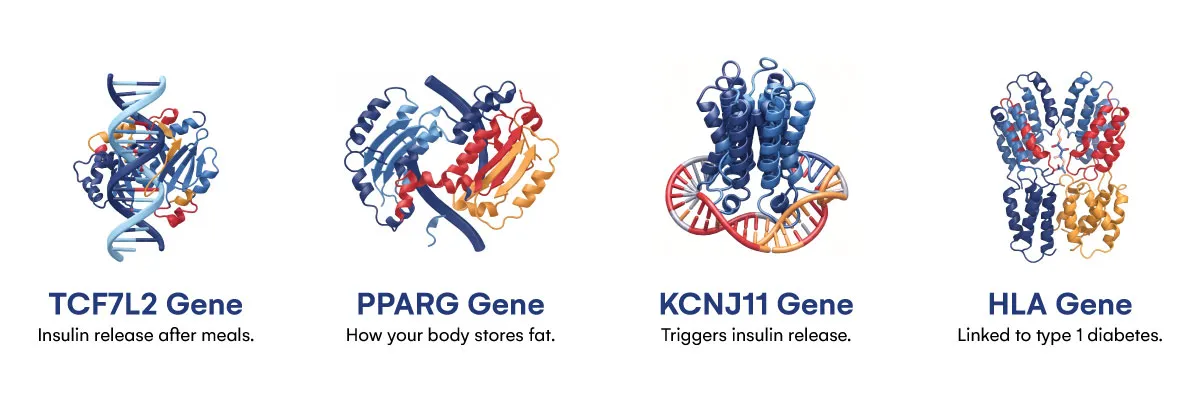
The Genes Most Often Linked to Diabetes
 

  • If one parent has type 2 diabetes, your lifetime risk goes up by roughly 30 to 40 percent. 
  • If both parents have it, your risk crosses 50 percent. 
  • Type 1 diabetes also has a genetic side, but it usually needs a trigger, such as a viral infection, before it develops. 

Family history is a signal. It is not a diagnosis. It tells you that your body may need more attention with food, movement, and regular checkups than someone with no family history at all. What you do with that signal is where the real outcome gets decided. 
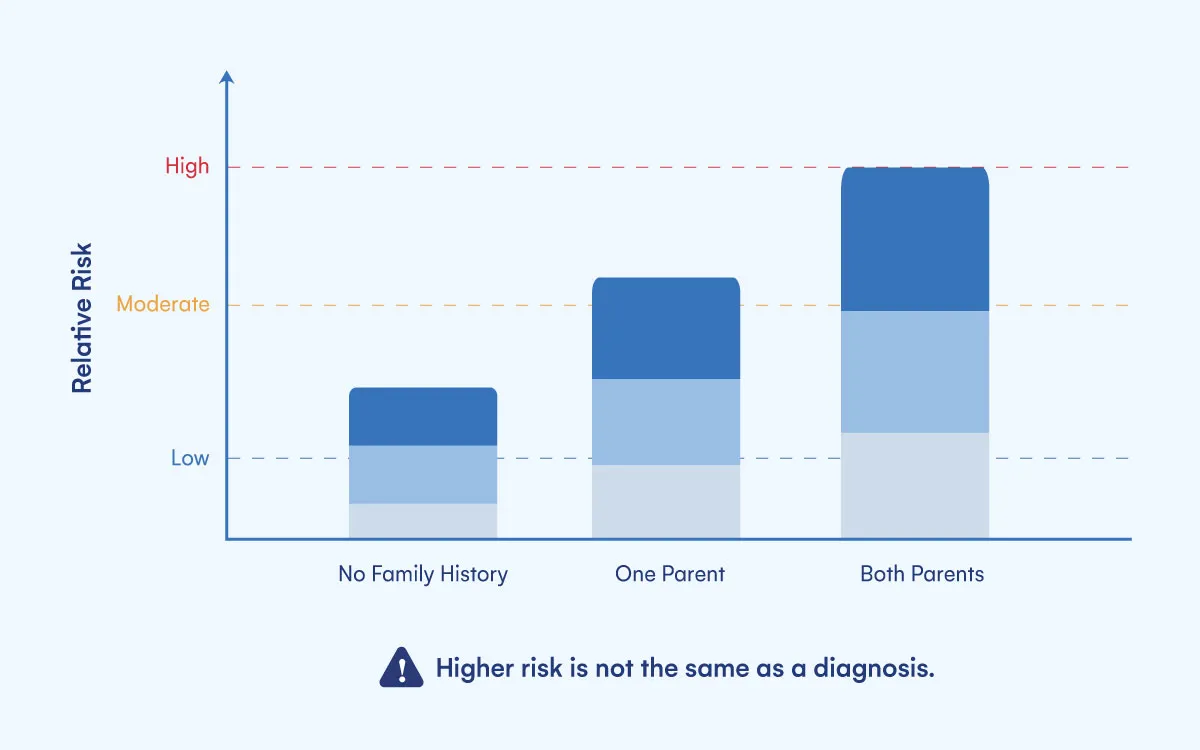
How Much Does Family History Raise Your Risk?

This is not a faraway problem. It is happening around us right now. 

  • India has around 89 million people living with diabetes, the second highest number in the world. 
  • Nearly one in two people with diabetes in India do not know they have it, because the early stage often has no symptoms. 
  • The ICMR-INDIAB study found that Indians get about 62 percent of their daily calories from carbohydrates. That is one of the most carbohydrate heavy diets in the world. 
  • Some state level studies show diabetes crossing 20 to 25 percent in parts of urban and semi urban India, especially in southern cities.

That is close to the entire population of Germany living with a condition that, in a very large number of cases, could have been delayed or managed better with earlier awareness. 

 Diabetes also plays out differently depending on where in India you live. There is no single thing called Indian food. A plate in Punjab looks nothing like a plate in Kerala, and that difference matters. 

Your genes do not change based on your state. But your daily food does change how those genes show up in your health. Here is how the two regions compare. 


Plates 

North India 

South India 

Staple grain 

Wheat (roti, paratha, naan) 

Rice (idli, dosa, plain rice) 

Typical carb load 

High, from refined wheat and ghee heavy gravies 

Very high, with polished white rice as the main calorie source 

Protein source 

Dairy such as paneer and lassi, plus rajma and chole 

Mostly plant based, from lentils, coconut, and some dairy 

Cooking style 

Rich curries with visible oil and ghee 

Steamed items like idli and dosa, along with fried snacks and sambar rice combinations 

Lifestyle pattern 

Higher dairy fat intake in some states, lower activity in winter 

Higher urbanisation and desk based work, especially in Chennai, Bangalore, and Hyderabad 

Reported diabetes trend 

Rising fast in urban Delhi, Punjab, and Haryana as lifestyles change 

Historically among the highest in the country, with Tamil Nadu, Andhra Pradesh, Telangana, and Kerala reporting high rates 

Researchers who study Indian diets keep landing on the same point. This is not really a wheat versus rice fight. Diets in both regions are heavy on carbohydrates overall, and protein intake stays low almost everywhere, whether the staple is roti or rice. 

So the question your body is really responding to is not rice or wheat. It is how much total carbohydrate and how much real protein you eat every day. And the right answer to that is different for every person, because every body processes carbs, fat, and protein a little differently. 
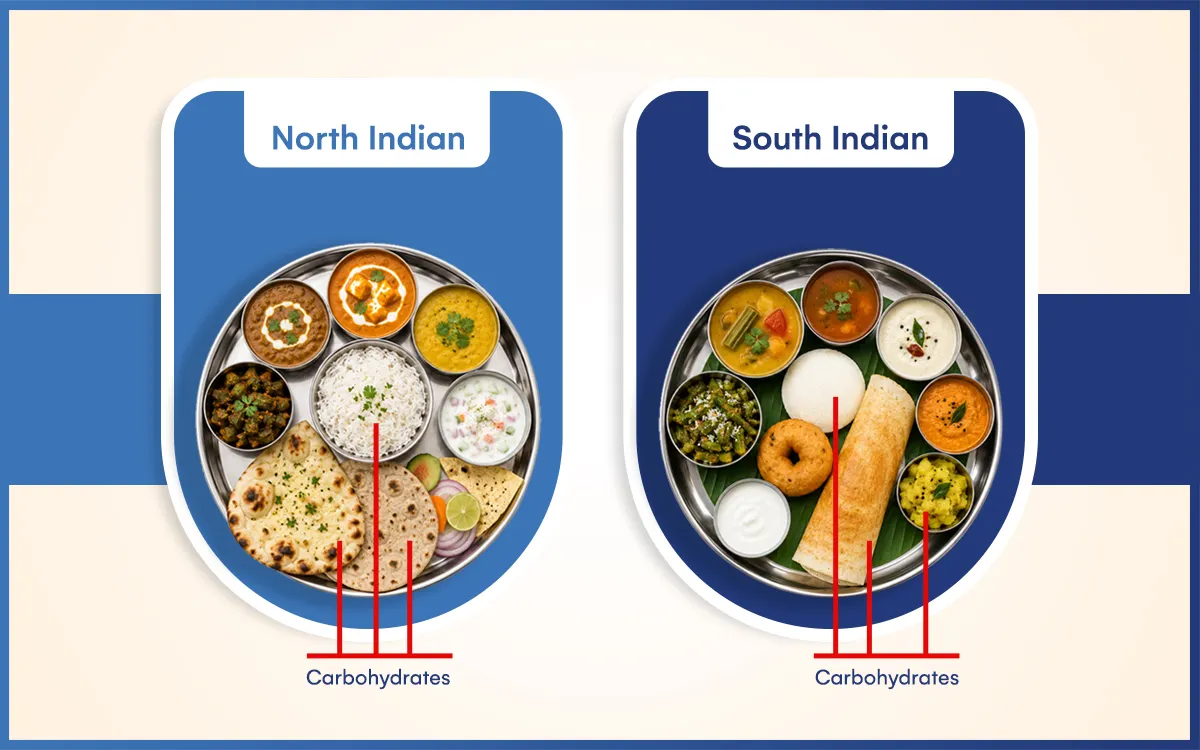
North India vs South India: Same Genes, Different Plates

Your genes influence your risk. Your diet influences what happens next. There is solid research behind that.

In the Diabetes Prevention Program study, people at high risk for type 2 diabetes cut their chances of actually developing it by around 58 percent, simply by changing their diet and adding regular physical activity. No medicine was involved. Their genes had not changed at all. Their daily habits had.

This works because genes do not act alone. What you eat, how much you move, how well you sleep, and even your stress levels can turn the activity of certain genes up or down. Researchers call this field epigenetics.

A gene linked to poor insulin response does not behave the same way in someone eating a balanced, protein rich diet as it does in someone living on high carb meals and long hours at a desk. Same gene. Different result. It depends on the environment you place it in.

So yes, you can change the outcome. The problem is that most people try to change it blind. 

Here is where most people get stuck

You find out diabetes runs in your family. You get worried. You cut sugar, stop rice for three months, start walking in the evening, and follow a diet chart a friend or a relative shared with you. Then six months later your report looks almost the same as before, and you have no idea why.

Meanwhile someone else follows the exact same plan and their HbA1c drops nicely.

This happens more often than people realise, and it is not about willpower. Consider what a generic diet chart is actually built on.

  • Same diagnosis does not mean same biology. Two people can both be pre diabetic and have very different reasons for it. 
  • Same blood sugar does not mean same response to food. One person may spike sharply after rice while another handles it comfortably. 
  • Same calories do not mean same result. How your body uses fat, protein, and carbohydrate is not identical to your neighbour’s. 
  • Generic plans are built around averages. They are designed for the middle of a large group, and almost nobody is exactly in the middle. 

This is the part worth sitting with for a minute. If you have been following general advice and it has not worked well for you, the advice was probably not wrong. It just may not have been built for your body.

So the real question is not “which diet is best.” It is “which diet is best for me,” and that needs information about you specifically. 

Family history gives you a warning. It does not give you detail.

Knowing that your father has diabetes tells you to be careful. It does not tell you how much carbohydrate suits your body, whether you handle fat well, or which nutrients you are likely to fall short on.

A genetic test adds that layer of detail. It reads the variants you actually carry and turns your family history from a vague worry into information you can act on. 

Two important things to be clear about.

First, a DNA report is not a diagnosis and it is not a prediction. It does not tell you that you will get diabetes, and it does not replace your doctor or your blood tests.

Second, DNA on its own does not decide your diet. What it does is add biological information about you that can be used along with your blood reports, your weight, your food habits, your activity levels, and your family history. Put together, those things allow a nutritionist to build a plan that fits you instead of a plan that fits the average person.

That is the honest version of the value, and it is still a big one.
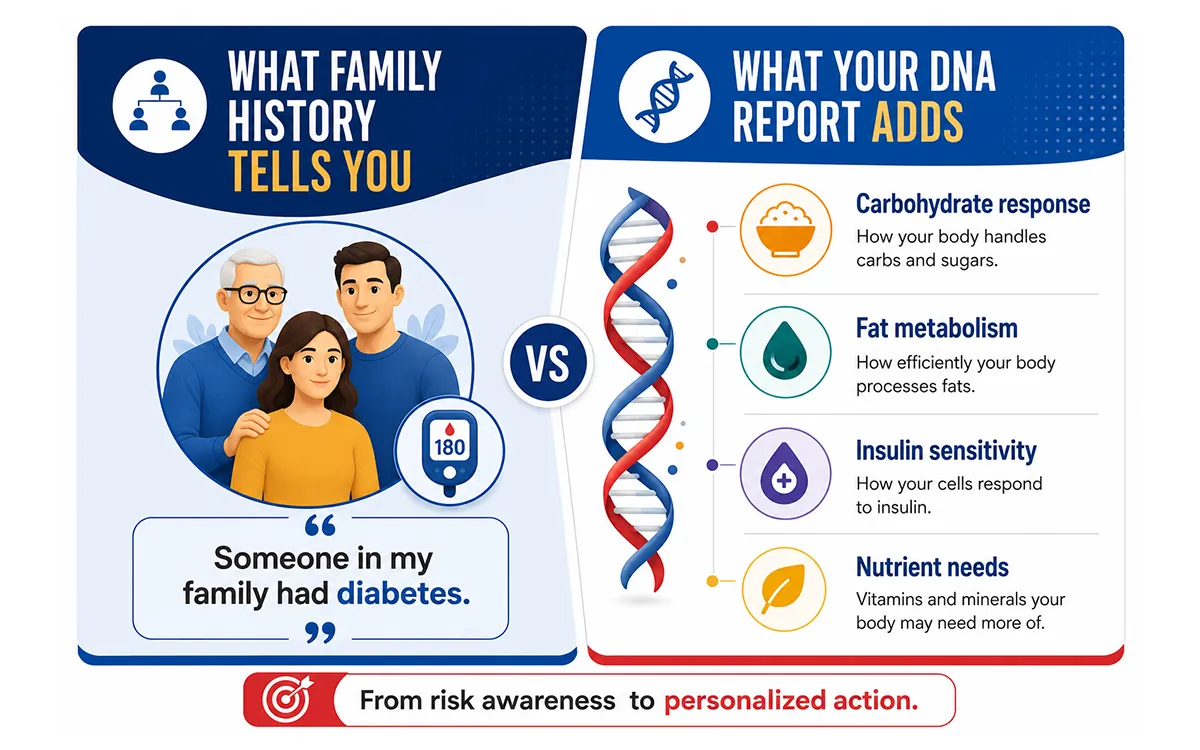
Your Family History Tells You There Is a Risk. Your DNA Can Tell You More.

If you are wondering what changes in practice, here is the kind of information a genetic report can add to your plan.

  • Carbohydrate response: how well your body is likely to handle a high carbohydrate meal, which helps decide how much rice or roti belongs on your plate rather than removing both. 
  • Fat metabolism: whether your body handles dietary fat efficiently, which affects how much oil, ghee, coconut, and nuts your plan should include. 
  • Insulin sensitivity related variants: helps guide meal timing and how carbohydrates should be spread across the day. 
  • Protein requirement: useful in India, where low protein intake is one of the most common gaps in an otherwise healthy looking diet. 
  • Vitamin and micronutrient processing: variants linked to vitamin D, B12, and folate processing, which matter because deficiencies here are extremely common in Indian adults. 
  • Exercise response: whether your body responds better to endurance activity or to strength work, so your effort goes where it actually counts.

None of this is magic. It is simply more information about you than a standard chart has, and better information usually means fewer wasted months. 

This is the part most people do not realise, and it changes how you should think about the cost.

A blood sugar test tells you what is happening in your body today. It changes with your weight, your stress, your last few weeks of eating. That is why you repeat it every few months, year after year. 

Your DNA is different. Your genetic code is essentially the same at 25, at 45, and at 65. It does not need to be re measured.

So a genetic test is not a recurring expense. You do it once, and the report stays useful for the rest of your life. You can come back to it when your weight changes, when your diet plan changes, when you start a new fitness routine, or when your doctor changes your medication. It is one of the very few health tests you genuinely never have to repeat.

Test once. Understand how your body is built. Use that as a base for every nutrition decision you make from here on.

You already know diabetes runs in your family. What you probably do not know is how your own body handles carbohydrates, fat, and insulin, and that is the part that decides whether a diet plan actually works for you.

The Lifecode genetic test reads that once. Your diet plan is then built using your report along with your health reports and your food habits, and it is guided by qualified nutrition experts throughout. 

Take the Lifecode Genetic Test and Get Your Personalised Diet Plan

One test. One report. Information you can use for the rest of your life, because your DNA does not change. 

FAQ

Frequently Asked Questions

Both have a genetic side, but they work differently. Type 2 diabetes is influenced by many genes acting together along with lifestyle factors. Type 1 diabetes involves genes related to the immune system and usually needs an outside trigger, such as a viral infection, before it develops.

No. Your risk is higher, often above 50 percent in studies, but it is not guaranteed. Diet, weight, physical activity, and sleep continue to play a major role in whether that risk actually turns into diabetes. 

Not as a prediction, no. A DNA test cannot tell you that you will or will not get diabetes. What it can do is show which risk linked variants you carry, so you can plan your diet and lifestyle before a diagnosis instead of reacting after one. 


A generic plan is built on what tends to work for people in general. A DNA based plan adds a layer of personalisation on top of that, by taking into account genetic variations that may influence how your body responds to carbohydrates, fat, protein, and insulin.

It does not replace medical advice and it does not guarantee reversal. What it does is reduce trial and error. Instead of following a plan for three months to find out whether it suits you, you start with a plan that already accounts for how your body is built. For most people, that is the difference between guessing and having a starting point.

No. Your DNA does not change as you age. Blood sugar, cholesterol, and weight all move around over time, which is why those need repeating. Your genetic makeup stays essentially the same, so one test gives you a reference you can keep using alongside your changing health reports.

Yes, though the purpose shifts. Instead of assessing risk, the report is used to help personalise your nutrition plan while you manage the condition. It works alongside your current medication, your HbA1c, and your doctor’s guidance, not instead of them. 

Not by itself. Indian studies point to total carbohydrate intake combined with low protein intake as the real problem, no matter whether the carbohydrate comes from rice, wheat, or millets. Swapping one grain for another rarely helps unless your total carbohydrate load and your protein quality both improve. 

August 19, 2026 Uncategorized
Last Updated On August 19, 2026