Is Cancer a Genetic Disease? What Your Genes Say and Why Your Diet Still Matters
- Genes Matter: Cancer Starts Inside the Cell
- How big is the problem?
- Inherited conditions that raise risk
- What else adds to risk
- Diet Often Decides How Far the Risk Goes
- Diet during treatment and recovery
- A DNA-Based Diet Is More Precise
- So Take the Test Once and Use It With Your Care Team
- What a genetic test cannot do
Yes, in one sense. Cancer starts when genes inside a cell change and the cell grows out of control. But most of those changes happen during life. Researchers estimate that only about 5% to 10% of cancers are passed down from a parent to a child. Your genes can raise or lower your starting risk. What you eat, your weight, tobacco, alcohol, and regular screening then help shape how that risk plays out. American Cancer Society
If cancer has touched your family, this question probably crossed your mind at some point. You may have wondered if you are next, or if your children are. This guide explains what genes do, what they do not do, and how food fits in. It also covers when a one-time genetic test may be worth talking about with your doctor.
Genes Matter: Cancer Starts Inside the Cell
Think of your genes as an instruction manual. Each cell reads it to know when to grow, when to repair damage, and when to stop. Cancer begins when enough of those instructions get damaged that a cell ignores the rules.
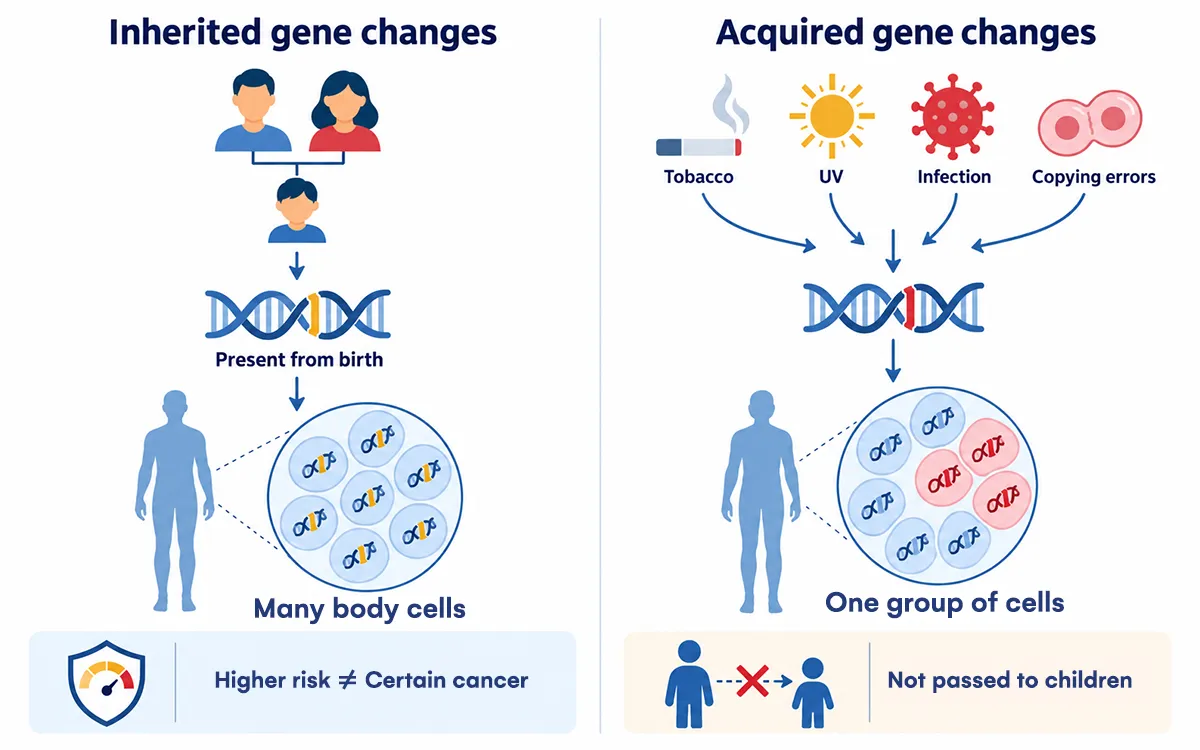
Gene changes reach a cell in two ways:
- Acquired changes happen during your lifetime. Causes include tobacco smoke, sun exposure, infections, and random copying errors when cells divide. These changes stay in that group of cells. They are not passed to your children.
- Inherited changes are present from birth in almost every cell. A parent passed them on. They can raise the chance of certain cancers, but they do not mean cancer will happen.
Most cancers come from acquired changes. That is why cancer is common even in families with no history of it.
How big is the problem?
The numbers help explain why this topic matters:
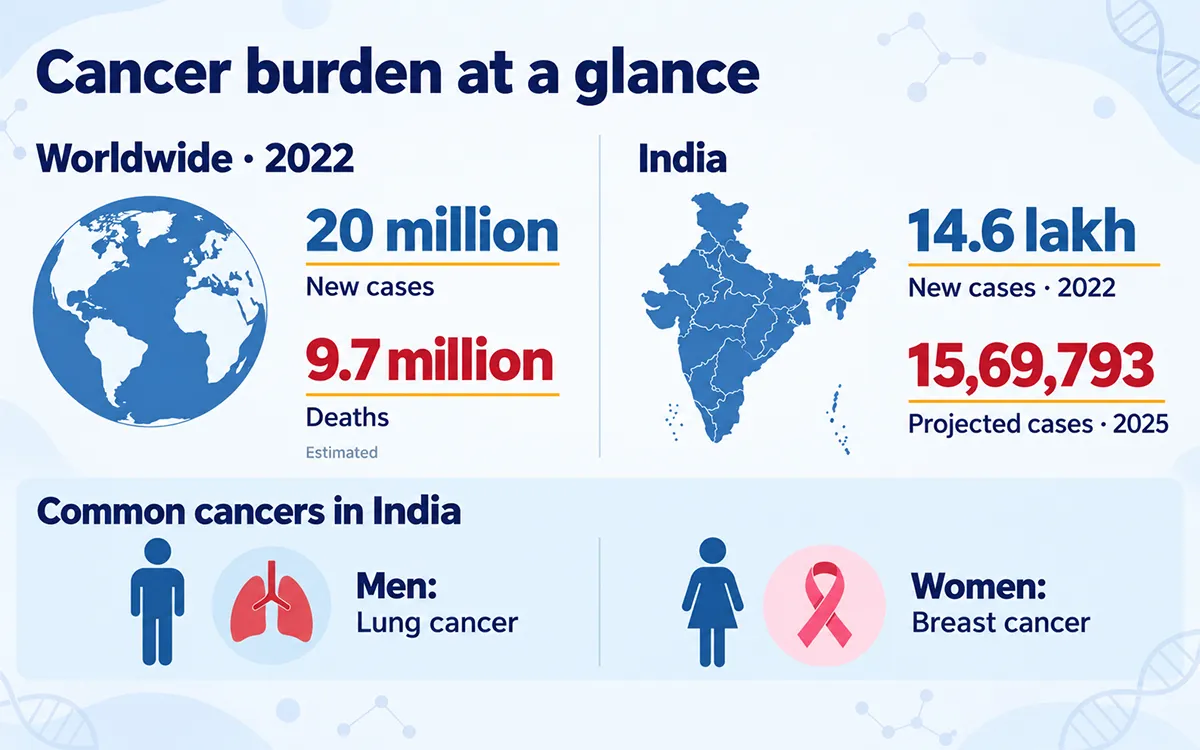
- In 2024, about 21 million people worldwide were newly diagnosed with cancer, and nearly 10 million died from it. American Cancer Society
- In India, ICMR estimated about 14.6 lakh new cases in 2022, and about one in nine people is likely to develop cancer in their lifetime. nih
- The ICMR estimate for 2025 is 15,69,793 cases. sansad
- Lung cancer in men and breast cancer in women are the most common types in India. nih
Inherited conditions that raise risk
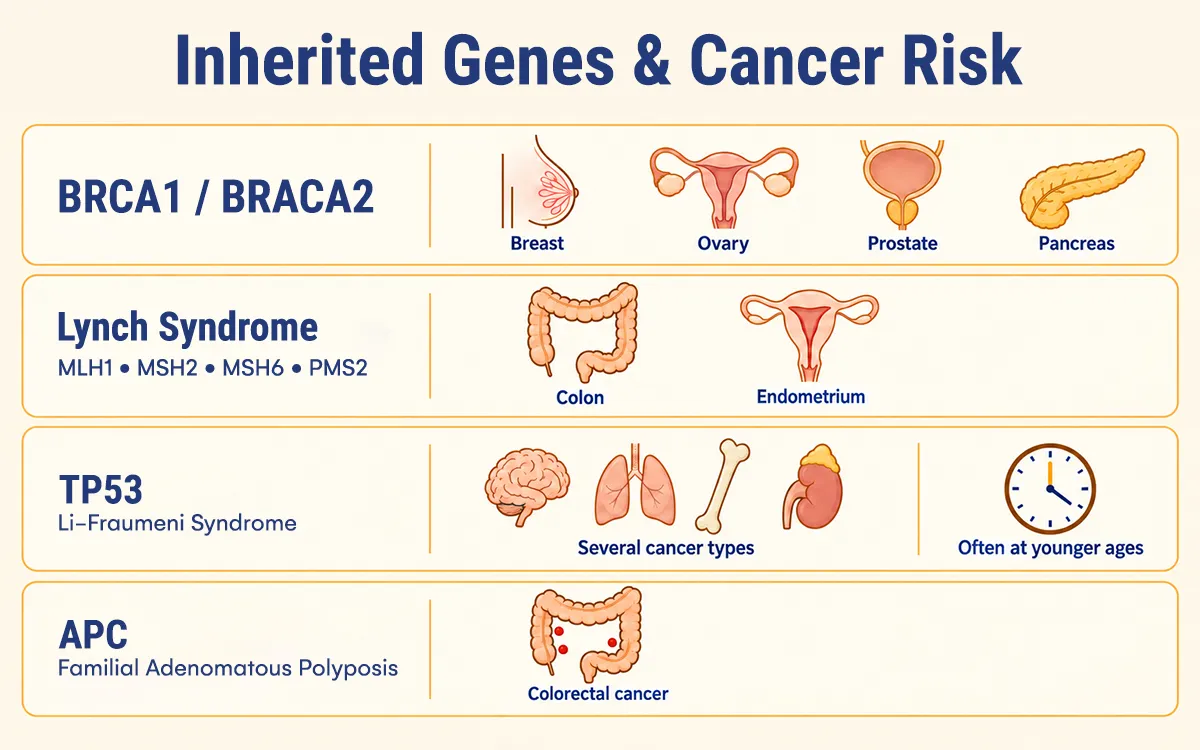
A small group of families carry gene changes that raise the chance of specific cancers. Doctors call these hereditary cancer syndromes. Some well-known ones are:
- BRCA1 and BRCA2: linked to breast, ovarian, prostate, and pancreatic cancers
- Lynch syndrome (MLH1, MSH2, MSH6, PMS2): linked to colon and womb cancers, among others
- Li-Fraumeni syndrome (TP53): linked to several cancers, often at younger ages
- FAP (APC): linked to colon cancer
These are a minority of all cases. Still, for a family that carries one, the information can change how doctors plan screening.
But Genes Are Not Destiny
Here is the part that gets lost in family stories. Carrying a gene change raises the chance of cancer. It does not decide the outcome. Some people with a high-risk variant never develop cancer. Many people with no family history do.
Not every cancer that seems to run in a family comes from an inherited syndrome, because cancer is common and several relatives can be affected by chance. A grandmother with lung cancer who smoked for forty years tells a different story than a mother and aunt who both had breast cancer before 45. American Cancer Society
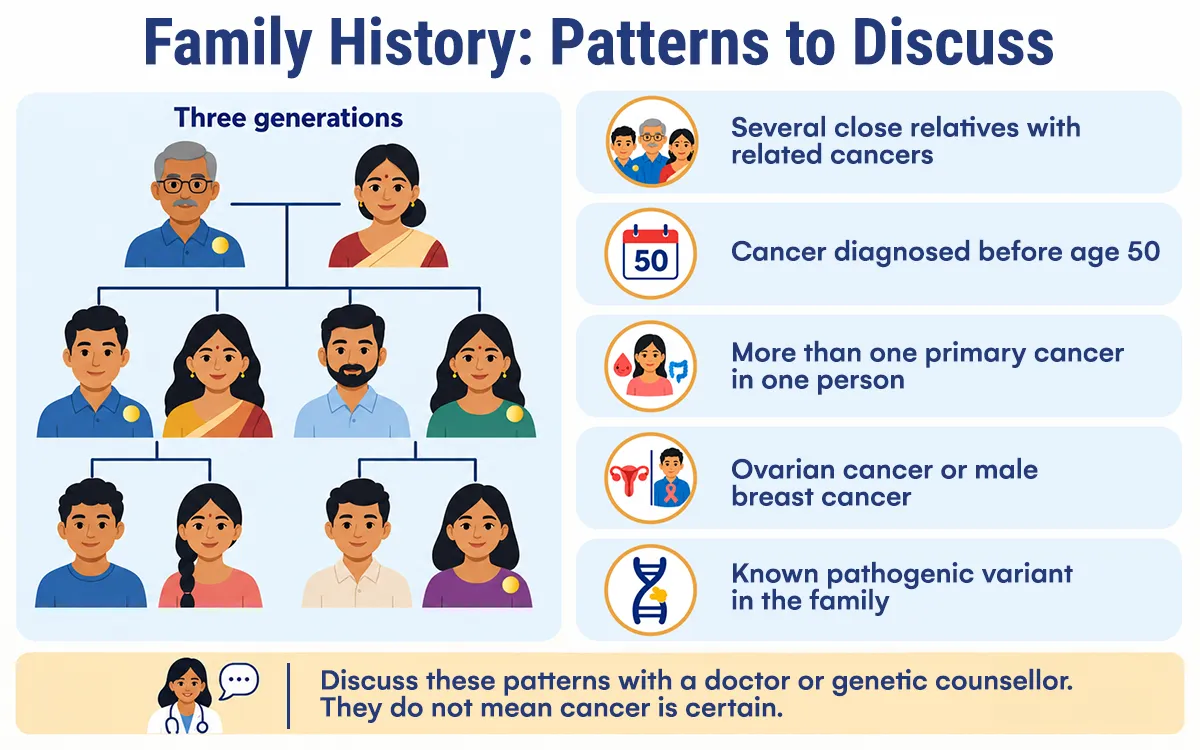
Doctors look for certain patterns before they suspect a hereditary cause:
- Several close relatives with the same or related cancers
- Cancer at a younger age than usual, such as before 50
- One person with more than one cancer
- Ovarian cancer, or breast cancer in a male relative
- A gene change already found in a relative
If your family fits one of these, mention it to your doctor. If it does not, that is still useful for your doctor to know.
What else adds to risk
For most people, everyday factors count for a lot. The World Cancer Research Fund says up to 40% of cancer cases are preventable if people avoid smoking, sun damage, and alcohol, eat a healthy diet, keep a healthy weight, and stay active. In India, tobacco in all forms, including gutka and paan with areca nut, is a major risk for mouth cancer. Infections such as HPV and hepatitis B also play a role, and vaccines exist for both. World Cancer Research Fund
So the honest answer to “is cancer genetic?” has two parts. Genes set the starting point. Life adds or removes risk along the way.
Diet Often Decides How Far the Risk Goes
Of all the things you can change, food is one of the few you control every day. It also connects to other risks. What you eat affects your weight, your blood sugar, and how much inflammation your body carries.
Research supports this. In one study of more than 54,000 Swedish adults, people who followed the WCRF/AICR recommendations most closely had a lower risk of cancer than those who followed them least, and each extra point in the score was linked to a 3% to 4% lower risk. That is a group result, not a promise for any one person. But it shows that daily habits add up. nih
Patterns linked with higher cancer risk include:
- Frequent alcohol use
- Regular intake of processed meats such as sausages and packaged salami
- Sugary drinks and heavily processed snacks
- Very low fibre intake
- Carrying extra weight for many years
Patterns linked with lower risk include:
- Plenty of vegetables, fruit, whole grains, dal, and beans
- At least 30 grams of fibre a day from food. nih
- Limiting red meat, fast food, and packaged foods
- Staying active most days of the week
Most people fall short of this. In that same Swedish study, more than 90% of participants did not meet the advice on plant foods, red and processed meat, and fast food. nih
Diet during treatment and recovery
Food matters after a diagnosis too, but the goals change. During treatment, the aim is often to keep enough calories and protein in your body. Chemotherapy and radiation can cause nausea, mouth sores, taste changes, and weight loss. A plan that suits a healthy person trying to lower risk may not suit someone in treatment.
In recovery, many people want to know what to eat to stay well. The WCRF/AICR recommendations can be extended to improving cancer survival, but little is known about how much these habits change survival. That is why guidance from an oncology dietitian matters. They work with your treatment team and adjust advice for your cancer type, medicines, and lab reports. nih
But a Generic Diet Is Guesswork
If food matters this much, the next step seems easy: “eat healthy.” The trouble is that most diet advice is written for an average person. You are not an average person.
Consider how different two people can be:
- One person breaks down certain vitamins well. Another needs more of them to reach the same level.
- One person gains weight easily on the same meals that leave a sibling lean.
- One family carries a high-risk gene change. Another carries none.
- One person is vegetarian and diabetic. Another eats meat and has high cholesterol.
A printed diet chart, a forwarded message, or a trending “cancer-fighting food list” cannot see any of this. It treats everyone the same. During recovery the gap can be larger. Someone might cut out foods they need, or start high-dose supplements that do not suit their treatment. The WCRF/AICR guidance advises against using supplements to try to lower cancer risk. Always check with your care team before adding any. nih
The result is guesswork. You may work hard at a plan and still not know if it fits your body.
A DNA-Based Diet Is More Precise
This is where genetic information can help. The field is called nutrigenomics. It studies how genes affect the way your body handles food and nutrients. People can respond differently to the same diet because of their genes. MDPI
A DNA-based plan starts from your own results rather than a general chart. A report may look at:
- Inherited cancer risk genes, such as BRCA1, BRCA2, and Lynch syndrome genes, which help your doctor plan screening
- Nutrient handling genes, which relate to folate, vitamin D, and omega-3 fats
- Weight and fat metabolism genes, which relate to how your body stores and uses energy
A dietitian can use this along with your blood tests, health history, and food habits. The plan then reflects both your biology and your daily life, including regional food, fasting days, and family meals.
There are some early signs this approach can help. Studies report that personalised nutrition improved nutritional status and quality of life in colorectal cancer survivors. Some of these studies are small. ScienceDirect
In fairness, the science is still young. Studies linking nutrigenomics with cancer prevention are still in their infancy. A genetic report is not a treatment, and it cannot tell you exactly what to eat. Think of it as a more detailed starting point that a qualified professional can turn into a plan. It works best next to, and not instead of, standard cancer prevention advice. ScienceDirect
So Take the Test Once and Use It With Your Care Team
Inherited DNA does not change over your lifetime. That is why a genetic test looking at inherited variants is usually done one time. A saliva or blood sample is enough. The scientific meaning of some results can be updated as research grows, so it is worth reviewing your report with your doctor from time to time.
Who might consider it
- People with a close relative who had cancer at a young age
- Families with several members affected by the same or related cancers
- People with a known gene change in the family
- Cancer survivors who want to plan diet and follow-up with more information
- Anyone with a family history who wants to speak to a professional before symptoms appear
A sensible way to go about it
- Write down your family history. List each relative, the type of cancer, and the age at diagnosis. Cover at least two generations, on both sides.
- Talk to your doctor or a genetic counsellor first. They can tell you if testing suits your situation and which test to choose.
- Choose a test that includes counselling. Results can be hard to read alone. Some tests return “uncertain” results, and these happen more often in groups that have been studied less, which can include Indian populations.
- Share the report with a dietitian. Ask them to build meals around it, using your blood work, culture, and taste.
- Keep up regular screening and check-ups. A test result does not replace them.
What a genetic test cannot do
- It cannot diagnose cancer.
- It cannot say whether you will or will not get cancer.
- A “no variant found” result does not mean zero risk.
- It cannot replace mammograms, Pap or HPV tests, oral checks, or other screening.
You may also want to think about how you would feel about each type of result, and whether you would share it with relatives, since their health may be affected too.
Wondering where to begin?
Start with a family history list and a short talk with your doctor or a genetic counsellor. If a test makes sense, ask how the results can be used by a registered dietitian to build a food plan for your own risk and recovery needs.
When to See a Doctor
Do not wait for a family pattern before getting symptoms checked. See a doctor if you notice:
- A lump in the breast or elsewhere that does not go away
- A mouth ulcer or white or red patch that does not heal in two to three weeks
- Blood in stool or a lasting change in bowel habits
- Unexplained weight loss or ongoing tiredness
- Bleeding between periods or after menopause
- A cough or hoarse voice that lasts
Most of these have other causes. Still, they are worth checking.
Reference
- National Cancer Registry Programme, India. Indian J Med Res. 2022 Pubmed
- American Cancer Society. Genes and Cancer.
Medical Disclaimer
This article is for general information only and is not medical advice, diagnosis, or treatment. Decisions about screening, genetic testing, diet, and supplements should be made with a qualified doctor, genetic counsellor, or oncology dietitian. A genetic test cannot diagnose cancer or predict whether you will get it, and it does not replace screening or treatment. If you have symptoms, see a doctor promptly.
FAQ
Frequently Asked Questions
Only some of it. About 5 to 10 percent of cancers are linked to inherited gene changes. Most come from changes that build up over a lifetime.
Not necessarily. It depends on the type of cancer, her age at diagnosis, and whether a hereditary cause was found. A doctor can help you judge your own risk.
Diet is one part of a bigger picture. Weight, exercise, tobacco, alcohol, vaccines, and screening also matter. Food can help, but no diet removes risk.
No. It is a way to plan food choices using your genetic information. It supports your medical care and does not replace it.
No. It shows whether you carry certain variants linked to higher risk. It cannot say whether or when cancer will develop.

Is Arthritis Genetic? What Indian Families Should Know Before It Becomes a Problem
Is Arthritis Genetic? What Indian Families Should Know Before It Becomes a Problem Arthritis Is Not One Disease So, Is Arthritis Genetic? Here Is What the Research...

Is Rheumatoid Arthritis Genetic? The Link Between Your DNA and Your Joints
Is Rheumatoid Arthritis Genetic? The Link Between Your DNA and Your Joints Is Rheumatoid Arthritis Hereditary or Genetic? There's a Real Difference How Genetics Actually Plays Into...