


Is knee pain following through Is Arthritis disease genetic
Is Arthritis Genetic follow our roots

Is Arthritis Genetic? What Indian Families Should Know Before It Becomes a Problem

Yes, arthritis has a genetic component, but genetics is not the whole story. Rheumatoid arthritis shows a stronger inherited link through specific gene variants, while osteoarthritis and gout are influenced by a mix of inherited joint traits and lifestyle factors like weight, diet, and joint use over the years. In other words, genes can raise or lower your starting risk, but they rarely decide the outcome on their own. 

If a parent, aunt, or grandparent in your family has dealt with joint pain, this single fact probably matters more to your future than you realise. Keep reading, because the difference between “arthritis runs in my family, so what can I do” and “arthritis runs in my family, so it’s inevitable” often comes down to information you can actually act on.

Before going further, it helps to understand that “arthritis” is an umbrella term for more than 100 different joint conditions, and they do not all behave the same way in your DNA. The two most common types seen in Indian clinics are: 

  1. Osteoarthritis (OA): the “wear and tear” type, where the cartilage cushioning the joints breaks down over time. It is the most common form seen in older adults, particularly affecting knees and hips. 
  1. Rheumatoid Arthritis (RA): an autoimmune condition where the body’s immune system mistakenly attacks the joint lining, causing inflammation, pain, and eventually joint damage. It tends to appear earlier in life than OA and often affects smaller joints like fingers and wrists first. 

Other forms include gout, linked to uric acid metabolism, psoriatic arthritis, ankylosing spondylitis, and juvenile idiopathic arthritis. Each has a different relationship with genetics, so lumping them together as “arthritis runs in my family” can actually work against you when it comes to knowing what to do next. 
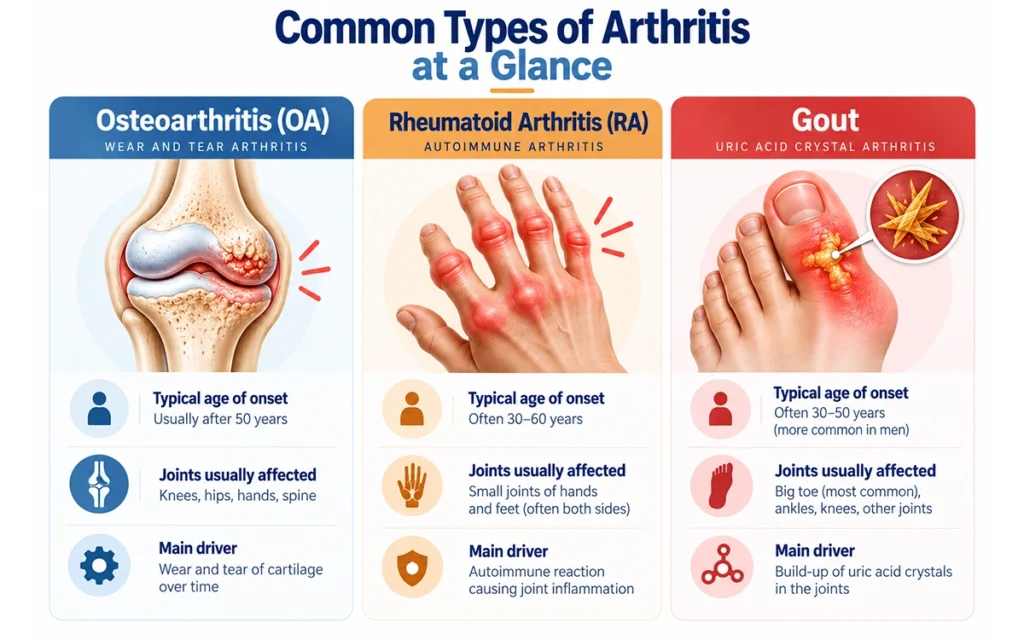
Osteoarthritis arthritis and Rheumatoid arthritis and Gout

Osteoarthritis: A Genetic Contribution, Not a Genetic Sentence 

Research suggests that genetics can influence a person’s likelihood of developing osteoarthritis, particularly in the hands, hips, and knees. Studies on twins and families have estimated that genetic factors may account for a meaningful share of the variation in OA risk, though the exact contribution differs by joint and by the population studied. 

What seems to be inherited isn’t “arthritis” itself, but underlying traits that make joints more vulnerable, such as: 

  • Cartilage structure and quality 
  • Joint alignment and shape, for example how the hip socket is formed 
  • Bone density patterns 
  • How the body regulates inflammation and connective tissue repair 

This means a family history of OA may point to an inherited susceptibility, but whether that susceptibility turns into actual disease depends heavily on lifestyle factors like body weight, physical activity, old injuries, occupational stress on joints, and diet. This is exactly why two siblings with the same parents can end up with very different joint outcomes by age 50. 

Rheumatoid Arthritis: A Stronger Genetic Link, Still Not Guaranteed 

RA shows a clearer genetic pattern than OA. Certain gene variants, most notably in a region called HLA-DRB1, have been associated with a higher likelihood of developing RA. Having a first degree relative, meaning a parent or sibling, with RA is generally understood to increase one’s own risk compared to the general population. 

However, having these genetic variants does not mean RA is inevitable. Many people carry RA associated gene variants and never develop the disease, while others without any known family history do develop it. Researchers believe RA develops through an interaction between genetic predisposition and environmental triggers. Smoking, certain infections, gum disease, and gut microbiome changes have all been studied as possible contributing triggers in genetically susceptible individuals. This is an important detail, because it means the genetic part of the story is only the setup, not the ending. 

Gout: Genes and Diet Working Together 

Gout, caused by excess uric acid crystallising in the joints, also has a documented genetic component. Certain gene variants affect how efficiently the kidneys clear uric acid from the body. This is particularly relevant in India, where a rise in gout cases has been linked to dietary shifts, including higher intake of purine rich foods, alcohol, and sugary beverages, layered on top of genetic predisposition in some individuals. 

The Bottom Line on Genetics and Arthritis

Across these forms of arthritis, a consistent pattern emerges. Genetics can raise or lower your baseline risk, but it rarely acts alone. Think of genetic predisposition as the terrain you are born with. Some people start on a gentler slope and others on a steeper one, while lifestyle, environment, weight, injury history, and ageing determine how far and how fast a person actually travels down that slope. 

So the real question is not “did I inherit arthritis risk.” Almost everyone inherits some level of risk for something. The real question is what you do with that information once you have it, and that is where most people, and most health advice, stop short. 

Genetic predisposition and Lifestyle environment

A few India specific factors make this genetics conversation particularly relevant: 

  • Joint loading lifestyle habits. Practices like sitting on the floor, squatting, which is common with Indian style toilets and daily chores, and climbing stairs multiple times a day place repetitive stress on knee and hip joints. This may interact with an inherited joint vulnerability to accelerate OA. 
  • Rising obesity and diabetes rates. Excess body weight is one of the strongest modifiable risk factors for knee OA, and India’s rapidly changing urban lifestyle has contributed to rising obesity rates, which can compound any inherited joint risk. 
  1. Delayed diagnosis culture. Joint pain is frequently normalised as an ageing issue in Indian households. This means RA in particular, a condition where early treatment substantially changes long term joint outcomes, is sometimes diagnosed only after visible joint damage has occurred. 
  1. Large, multi generational families. With many Indian families living in joint households or maintaining close contact across generations, family health history is often easier to gather here than in more fragmented family structures. This is a genuine advantage, if it is actually used. 

Before considering any test, the most accessible tool available to every Indian family is simply mapping out family health history. Ask: 

  1. Which relatives, including parents, grandparents, siblings, aunts, and uncles, have been diagnosed with arthritis, and which type? 
  1. At what age did symptoms begin? 
  1. Which joints were affected? 
  1. Were there related autoimmune conditions in the family, such as thyroid disorders, psoriasis, or lupus, since these sometimes cluster together? 

This costs nothing, takes one conversation over a family dinner, and gives any doctor you consult later a valuable starting point. But family history only tells you what happened to someone else’s body. It cannot tell you exactly what is happening inside yours, and that gap is where most people get stuck. 

This is where a modern option enters the picture: a one time genetic test that looks at inherited variants associated with joint and autoimmune conditions. 

It is worth being precise about what such a test can and cannot do. 

What a Genetic Test Can Offer 

  1. A clearer picture of your inherited predisposition to conditions like RA, or to specific OA related traits, based on current scientific understanding of associated gene variants 
  1. Context that, combined with family history and clinical evaluation, may help a doctor prioritise monitoring or earlier screening for at risk individuals 
  1. Since DNA does not change, the test is done once, and the underlying genetic data remains relevant for interpretation over your lifetime, even as scientific understanding of gene disease associations continues to evolve 
  1. A way to move from vague worry, such as “arthritis runs in my family,” to a more specific, informed conversation with a healthcare provider 

What a Genetic Test Cannot Offer 

  1. A diagnosis. Genetic testing indicates predisposition, not the presence of disease. 
  1. A guarantee. Since arthritis, especially OA and RA, results from gene environment interactions, no test can promise that a person will or will not develop the condition. 
  1. A replacement for clinical evaluation, blood tests such as RA factor or anti CCP for rheumatoid arthritis, or a rheumatologist’s assessment once symptoms appear. 

Framed accurately, the value of a one time genetic test lies in shifting the approach from reactive to proactive. Instead of waiting for joint pain, stiffness, or swelling to appear and only then investigating the cause, a person who understands their inherited risk profile can factor that into everyday decisions such as weight management, joint friendly exercise, dietary choices around purine intake, and knowing which early symptoms are worth a prompt doctor’s visit rather than being dismissed as “just stiffness.” 

For families with a documented history of RA in particular, this kind of awareness can support earlier conversations with a doctor if symptoms do appear. In RA, earlier diagnosis and treatment initiation is widely recognised as important for limiting long term joint damage. 

How a one time genetic test will work check here

If arthritis has appeared in your family, or you are simply curious about your joint health risk, a sensible path looks like this: 

  1. Document your family history across at least two generations, noting the type of arthritis where known. 
  1. Discuss your risk with a doctor, especially if you are experiencing any joint symptoms. Morning stiffness lasting more than 30 minutes, swelling, or pain that does not improve with rest can be worth flagging for RA specifically. 
  1. Consider a one time genetic screening as an additional data point, understanding that it complements, rather than replaces, clinical evaluation and family history. 
  1. Focus on the levers you can control, including maintaining a healthy body weight, staying physically active with joint friendly exercise such as swimming, cycling, or walking, managing blood sugar, and being mindful of diet if gout risk is a concern. 
  1. Do not wait for pain to become severe before seeking evaluation, particularly if your family history includes autoimmune arthritis. 

This brings us to the one factor that shows up in every single form of arthritis discussed above, genetic or not: diet. 

By now, one thing should be clear: your genes set the starting terrain, but they do not walk the path for you. Two people with the same inherited risk for RA, OA, or gout can end up in very different places twenty years later, depending on how they eat, move, and manage their weight. 

This is genuinely good news. It means your genetic report is not a prediction of your future, it is a map that shows you where to put your effort. And for arthritis specifically, one lever tends to matter more than almost any other: what you eat.

Body weight directly affects the load placed on knee and hip joints, so every extra kilogram carried is extra pressure on cartilage that may already be genetically more vulnerable. Purine rich foods, alcohol, and sugary drinks can push uric acid levels up in people who are genetically predisposed to gout. Inflammatory dietary patterns are being studied for their possible role in autoimmune conditions like RA in genetically susceptible individuals. In other words, for arthritis, diet is not a minor lifestyle detail sitting next to genetics. For many people, it is the deciding factor that determines whether an inherited predisposition stays dormant or becomes an active problem. 

The Problem With a Generic Diet Plan 

Here is where most people get stuck. If diet matters this much, the obvious next step should be simple: eat healthy. But “eat healthy” advice found online or from well meaning relatives is usually generic. It is built for an average person, not for your specific genetic profile. 

A one size fits all diet plan cannot tell you whether your body clears uric acid efficiently, whether you carry OA related joint traits that respond better to lower impact movement and specific nutrient support, or whether your inflammation regulation genes suggest a more anti inflammatory dietary pattern would help. Without that information, most dietary changes for joint health are essentially guesswork, applied uniformly to people whose underlying biology is not uniform at all. 

A DNA Based Diet Removes the Guesswork 

This is exactly the gap a one-time genetic test is designed to close. Instead of following a generic diet chart, your genetic data can help build a dietary and lifestyle approach that is actually built around your own joint and metabolic risk factors, informed by which gene variants you carry, guided by how your body is more likely to process uric acid, inflammation, and connective tissue repair, and used, alongside your doctor’s guidance, to prioritise the habits that matter most for your specific risk profile rather than generic advice that may not apply to you at all. 

The test itself takes a few minutes. The DNA does not change, so it only needs to be done once, and the insights it provides can inform your health decisions for years to come. 

Genes matter, but they are not destiny. Diet and lifestyle largely decide how that genetic story actually plays out. A generic diet plan, however well intentioned, is still a guess about a body it was never designed for. A DNA based approach replaces that guesswork with information that is actually yours. 

If arthritis runs in your family, or you simply want to stop guessing and start knowing, a one time genetic test is a practical, low effort way to move from vague family worry to a clear, personalised starting point, the kind you can actually act on with your doctor’s guidance.


Use the Insight for Life test one time in a life

Reference

  • Pubmed positive rheumatoid arthritis: all alleles are important
  • Rheumatoid Arthritis is genetics medlineplus

Medical Disclaimer

This article is for general informational and educational purposes only and does not constitute medical advice, diagnosis, or treatment. Genetic risk information does not confirm or rule out any condition. Always consult a qualified doctor or rheumatologist about joint pain, stiffness, swelling, or any health concern, and do not delay or disregard professional advice because of something you have read here.

FAQ

Frequently Asked Questions

Not necessarily. Having a parent with arthritis, especially osteoarthritis, may raise your risk somewhat, but it does not mean the condition is guaranteed. Lifestyle factors such as weight, activity levels, and joint use over the years play a major role in whether that inherited risk actually turns into disease. 

There is no single age that applies to everyone. Osteoarthritis symptoms typically appear from the late 40s onward, while rheumatoid arthritis can appear earlier, often between the ages of 25 and 50. If you have a strong family history, it is reasonable to mention this to a doctor during a routine checkup rather than waiting for symptoms.

No. A genetic test can indicate whether you carry variants associated with a higher likelihood of certain types of arthritis, but it cannot predict with certainty whether the disease will actually develop, since environmental and lifestyle factors also play a significant role.

Current research indicates that rheumatoid arthritis has a comparatively stronger and better defined genetic association, particularly through certain HLA gene variants, while osteoarthritis involves a mix of inherited joint traits and a larger share of lifestyle and mechanical wear factors.

This is a personal decision best made in consultation with a doctor. Some people prefer to understand their baseline risk profile before symptoms appear, so they can adjust lifestyle habits proactively, while others prefer to test only if symptoms or a strong family history prompt the question. 

September 28, 2026 Uncategorized
Last Updated On September 28, 2026