
Gene Overview
PER3 Gene
PER3 does not determine sleep quality alone, but it contributes significantly to how precisely the body times its internal biological rhythms — influencing the depth, architecture, and restorative quality of sleep as well as the synchronisation of cognitive performance, mood, and physiological recovery across the daily cycle.
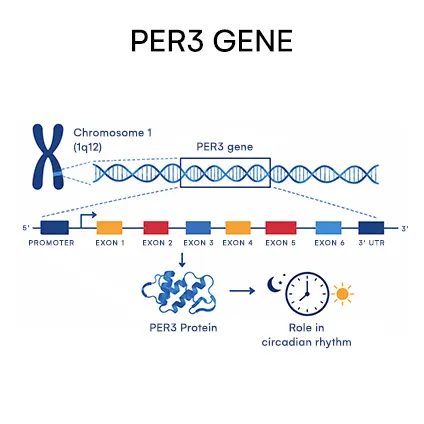
This gene encodes Period 3, a core component of the molecular circadian clock feedback loop that drives the rhythmic cycling of biological processes across a approximately 24-hour period. Certain variations are associated with differences in sleep architecture, sleep pressure accumulation, chronotype preference, cognitive vulnerability to sleep loss, and the resilience of mood and performance under conditions of disrupted or insufficient sleep.
Why PER3 Matters for Your Health
PER3 has broad implications across multiple sleep, brain, mood, and performance systems. Understanding PER3 helps explain why some people are naturally inclined toward earlier sleep and wake patterns, why the same amount of sleep produces very different levels of cognitive restoration between individuals, and why disrupted sleep affects mood, mental sharpness, and physical recovery so variably across the population.
Sleep Architecture
Influences the depth, staging, and restorative quality of sleep cycles particularly the proportion and quality of slow-wave deep sleep experienced each night
Chronotype & Sleep Timing
Shapes the natural biological preference for earlier or later sleep and wake timing, contributing to whether a person functions as a morning or evening type
Cognitive Resilience to Sleep Loss
Affects how significantly cognitive performance, reaction time, and mental clarity deteriorate in response to insufficient or disrupted sleep
Mood Regulation
Contributes to aspects of emotional stability and mood consistency through its role in rhythmic neurotransmitter cycling and the restorative brain processes that occur during adequate sleep
Physical Recovery
Influences the timing and efficiency of overnight cellular repair, growth hormone release, and physiological restoration processes that are coordinated by circadian clock mechanisms
Key Functions of PER3
- Encodes a core period protein within the molecular circadian clock feedback loop
- Contributes to the precise timing of sleep onset, sleep architecture, and wake transitions
- Regulates the accumulation and discharge of sleep pressure — the biological drive for sleep that builds during waking hours
- Influences the depth and proportion of slow-wave sleep and REM sleep within nightly sleep cycles
- Shapes cognitive and emotional vulnerability to sleep restriction and circadian disruption
- Contributes to the synchronisation of overnight hormonal and cellular recovery processes with the circadian timing system
- Modulates sensitivity to circadian misalignment, such as jet lag or shift work
How PER3 Variants May Influence You
This is not a diagnosis. It indicates tendencies that can be influenced through daily choices.
Higher Efficiency Variant
May support more stable sleep architecture, greater cognitive resilience to sleep disruption, and more consistent overnight physiological recovery tendencies aligned with the natural circadian cycle.
Moderate Variant
Typically indicates balanced circadian sleep function with no major advantage or limitation in sleep architecture, chronotype, or cognitive response to sleep variation.
Lower Efficiency Variant
May require stronger lifestyle support to maintain sleep depth and quality, protect cognitive performance during periods of sleep disruption, and sustain mood and energy consistency through robust sleep hygiene and circadian anchoring practices.
Scientific Foundation
Science Behind the PER3 Gene
The Molecular Circadian Clock & PER3
PER3 encodes the Period 3 protein, one of three period proteins that form the core negative feedback arm of the molecular circadian clock. Working within a transcription-translation feedback loop alongside CLOCK, BMAL1, CRY1, and CRY2, the PER3 protein accumulates during the active phase of the circadian cycle before feeding back to suppress its own production — a rhythmic oscillation that takes approximately 24 hours to complete and drives the timing of virtually all biological processes connected to the sleep-wake cycle. Notably, PER3 appears to play a modulatory rather than an essential role compared to PER1 and PER2, which are more critical for maintaining core circadian rhythmicity. Variants that alter PER3 function can shift the precision and stability of this molecular oscillation, affecting sleep timing, depth, and the overall robustness of the circadian system.
Sleep Architecture & Sleep Pressure Research
PER3 has been specifically linked to the regulation of sleep homeostasis — the biological system that governs how sleep pressure accumulates during waking hours and is discharged during sleep. Research has demonstrated that a well-studied length variant of PER3 is associated with significant differences in slow-wave sleep intensity, REM sleep distribution, and the degree to which cognitive and mood function deteriorates following sleep restriction. Individuals carrying certain PER3 variants show greater vulnerability in controlled sleep restriction studies to the neurobehavioral consequences of sleep loss, including impairments in sustained attention, working memory, and emotional regulation.
Chronotype & Diurnal Preference
Studies have associated PER3 variants with differences in chronotype — the biologically driven preference for earlier or later timing of sleep and peak performance periods across the day. These chronotype differences reflect genuine variation in the molecular speed and phase of the circadian clock rather than simply habitual or lifestyle-driven preferences, with PER3 variants contributing meaningfully to whether an individual’s optimal biological timing naturally aligns with conventional social schedules or diverges from them.
PER3, Mood & Psychiatric Vulnerability
Research has identified links between PER3 variants and differences in mood stability, seasonal mood variation, and vulnerability to mood-related challenges under conditions of circadian disruption. The connection between PER3 function, sleep architecture quality, and the overnight consolidation of emotional memory and stress processing creates a pathway through which disrupted PER3-related sleep patterns may susceptibility to mood-related challenges, particularly under conditions of chronic circadian disruption.
Gene Interactions
PER3 works in close coordination with genes including CLOCK, BMAL1, CRY1, CRY2, and PER1 and PER2, forming the interconnected molecular clock feedback network. It also interacts with genes influencing dopamine signalling, serotonin metabolism signaling pathways, and cortisol rhythmicity connecting circadian timing function directly to mood regulation, stress response, and cognitive performance pathways.
How Lifestyle Influences PER3
Although genes are fixed, PER3 expression, circadian clock precision, and sleep architecture quality is meaningfully and consistently shaped by lifestyle choices, light exposure patterns, and daily behavioural routines.
Nutrition
Consistent meal timing aligned with the natural light-dark cycle supports healthy PER3-driven circadian gene expression. Avoiding late-night eating and maintaining stable daily meal patterns help reinforce the molecular clock rhythms that PER3 regulates. Nutrients supporting serotonin and melatonin synthesis — including tryptophan-rich foods and magnesium — contribute to healthy sleep architecture aligned with PER3 function.
Sleep
Consistent, fixed sleep and wake times — maintained across all days of the week — are the most powerful behavioural anchors for PER3-driven circadian stability. Sleep timing consistency strengthens the molecular clock feedback loop, supports slow-wave sleep depth, and reduces the cognitive and mood vulnerability associated with reactive PER3 profiles. Sleep environment quality, including darkness, temperature, and noise management, directly supports the expression of PER3-related sleep architecture benefits.
Stress
Focused and consistent stress management supports PER3-associated circadian stability. Chronic stress elevates evening cortisol, which can disrupts the natural decline in arousal that PER3-regulated circadian timing coordinates to support sleep onset and deep sleep architecture. Regular wind-down practices and parasympathetic activation techniques help protect the integrity of PER3-driven sleep-wake transitions.
Movement
Regular physical activity particularly when performed at consistent times of day and avoiding high-intensity exercise close to sleep reinforces circadian entrainment, supports slow-wave sleep depth, and promotes the physiological recovery processes that PER3-related clock function coordinates overnight.
Habits
Long-term routine consistency matters more than short-term interventions — the molecular circadian clock system regulated by PER3 responds most powerfully to predictable, repeated daily patterns of light exposure, activity, meals, and sleep timing. Sustained behavioural anchors over weeks and months produce the most meaningful improvements in PER3-related sleep architecture and circadian stability.
Signs You May Benefit From Understanding PER3
How Lifecode Interprets PER3 in Your Report
Our comprehensive interpretation analyzes your PER3 variants alongside related circadian clock and sleep architecture genes to provide personalized insights into your chronotype tendencies, sleep depth and staging patterns, cognitive resilience to sleep disruption, and circadian timing stability. We categorize findings and prioritize actionable recommendations based on your complete genetic profile.
Lifestyle Guidance
Practical Recommendations
These are general lifestyle considerations, not medical advice.
Nutrition
Align meal timing with daylight hours where possible and avoid late-night eating to support circadian metabolic signalling.
Recovery
Establish and maintain fixed sleep and wake times seven days a week to anchor your circadian clock and support CLOCK gene rhythm stability.
Stress Management
Incorporate morning light exposure and evening wind-down routines to reinforce natural cortisol and melatonin cycling patterns.
Supplements
General circadian support and sleep-onset supplementation may be discussed during consultation.
Daily Habits
Focus on consistency over intensity — the circadian system is shaped by repetition, and stable daily anchors produce the greatest long-term benefit for sleep and overall biological rhythm health.
FAQ
Frequently Asked Questions
Your PER3 gene influences how quickly your internal clock re-synchronizes after disruption. Some people recover within a day while others experience prolonged fatigue and brain fog — a genuine biological difference, not a personal weakness.
Possibly. PER3 regulates how well your biological rhythms align with seasonal light changes. Reactive PER3 profiles can disrupt neurotransmitter cycling during shorter daylight months, contributing to noticeable mood dips and persistent low energy.
Your PER3 gene influences how efficiently your brain rebuilds mental clarity and emotional balance during sleep. Some people carry a genuine biological sensitivity that creates a neurological debt from just one disrupted night.
Yes. While your PER3 variant is fixed, consistent habits like fixed sleep times, morning light exposure, and aligned meal timing can meaningfully improve sleep depth, cognitive recovery, and mood stability over time.
- Fixed wake time daily — the strongest anchor for circadian stability
- Morning sunlight within one hour of waking — resets your molecular clock naturally
- Avoiding screens after 9 PM — protects melatonin rise and sleep onset
- Dinner before 7 PM — aligns metabolic and circadian signals effectively
- Consistent wind-down routine — signals your body to enter deep restorative sleep
Speak to a Lifecode Consultant
“Understanding “PER3″ helps you focus on resilience and recovery rather than chasing quick fixes.”