


is migraine genetic
is migraine genetic mob

Is Migraine Genetic? What's Really Behind Your Recurring Headaches

Yes, migraine is genetic to a meaningful degree. Twin studies put its heritability at roughly 40 to 60%. But very few people inherit migraine in a simple, guaranteed way. For most people, genetics sets the sensitivity, and specific triggers (stress, sleep, certain foods) decide when and how often an attack happens. 

If migraines have been part of your life for years and a parent or sibling deals with them too, it’s fair to wonder how much was written into your DNA before your first headache. 

If you’ve searched “is migraine genetic or not,” the honest answer is yes, but it can be misleading if you picture one faulty gene passed down like a family heirloom. 

Migraine is polygenic, meaning many genes, each with a small effect, combine to raise or lower your overall sensitivity. A 2022 genetic study of over 100,000 people with migraine identified 123 separate DNA regions linked to risk, most involved in blood vessel function and nerve signalling in the brain. No single gene decides the outcome. The combined effect of many small genetic nudges, plus your environment, determines whether migraines show up.
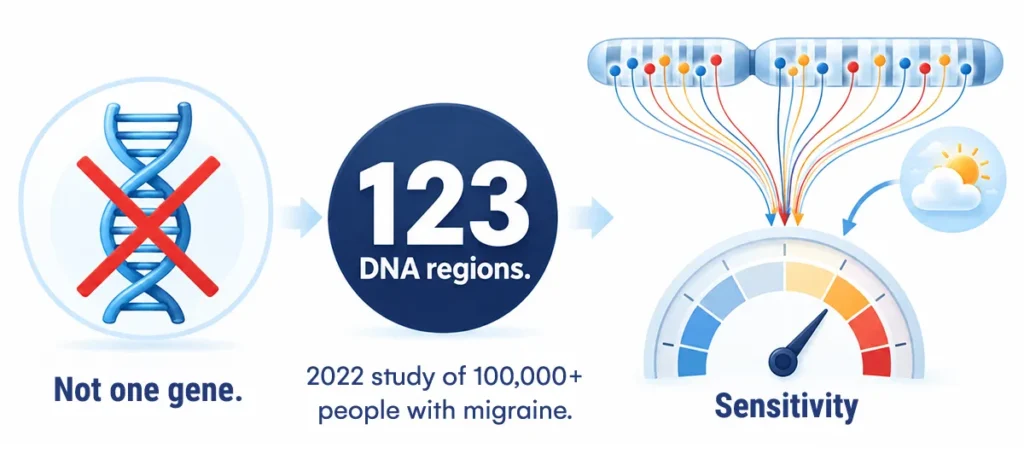
 Infographic showing migraine is a polygenic genetic disorder, with 123 DNA regions combining instead of one single gene.

Is Migraine a Genetic Disease or a Genetic Disorder? 

People use both terms, and both are broadly accurate. Migraine is a genetic disorder in the sense that inherited variations shape who is more sensitive to attacks. Migraine is a genetic disease in the same broad sense, but it is not caused by one gene. The exception is a rare form, covered in the next section.

These two words get mixed up constantly, and migraine shows why the difference matters. 

Common migraine, the type most people have, is genetic but not strictly hereditary. It doesn’t pass down in a predictable, guaranteed pattern. It clusters in families because of a shared polygenic tendency, not a single inherited mutation. 

Familial hemiplegic migraine (FHM) is the rare form that is hereditary in the classic sense. It is caused by a mutation in a single gene, most often CACNA1A, ATP1A2 or SCN1A, and follows an autosomal dominant pattern, so a parent with the mutation has roughly a 50% chance of passing it to each child. FHM causes temporary weakness on one side of the body during an attack and is far rarer and more serious than typical migraine. If migraine in your family comes with these symptoms, flag it to a neurologist directly. 

For almost everyone else, migraine is genetic in the broader, polygenic sense, not hereditary in the strict, single-gene sense. 
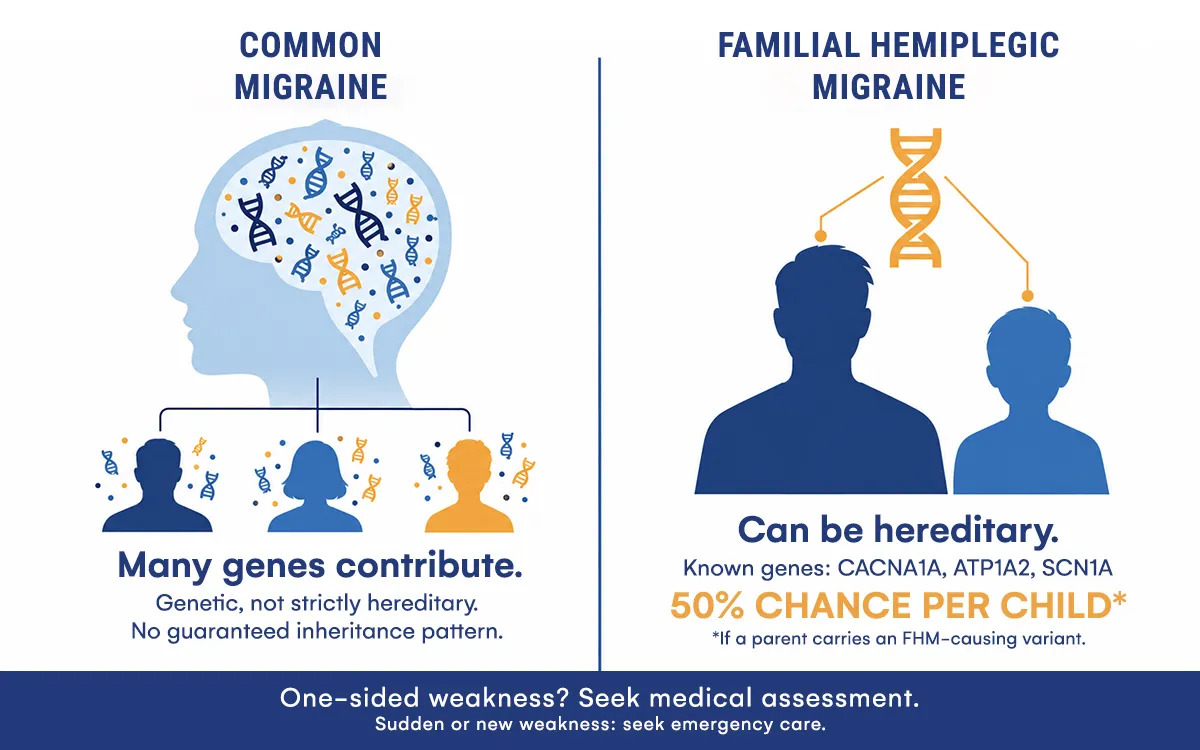
Comparison of whether migraine is genetic or hereditary: common migraine versus familial hemiplegic migraine.

Chronic migraine and vestibular migraine are also thought to sit on top of the same underlying genetic sensitivity. How often attacks happen, and what form they take, still depends heavily on triggers, sleep, stress and overall health. If you have frequent attacks, or dizziness and balance problems with your headaches, a neurologist can tell you which type you have and how to manage it. 

Migraine Is Genetic, So What Does Your Family History Tell You? 

Research on families and twins gives a clearer picture: 

  • If a first-degree relative has migraine without aura, you’re about twice as likely to have it too. 
  • If they have migraine with aura, your risk is about 1.4 times higher. 
  • Twin studies estimate heritability at 40 to 60%. Genetics accounts for a substantial share of who gets migraine, and the rest comes down to triggers and environment. 

A family history raises your baseline risk. It doesn’t guarantee migraines, and it doesn’t explain why some people get them twice a year and others twice a week.
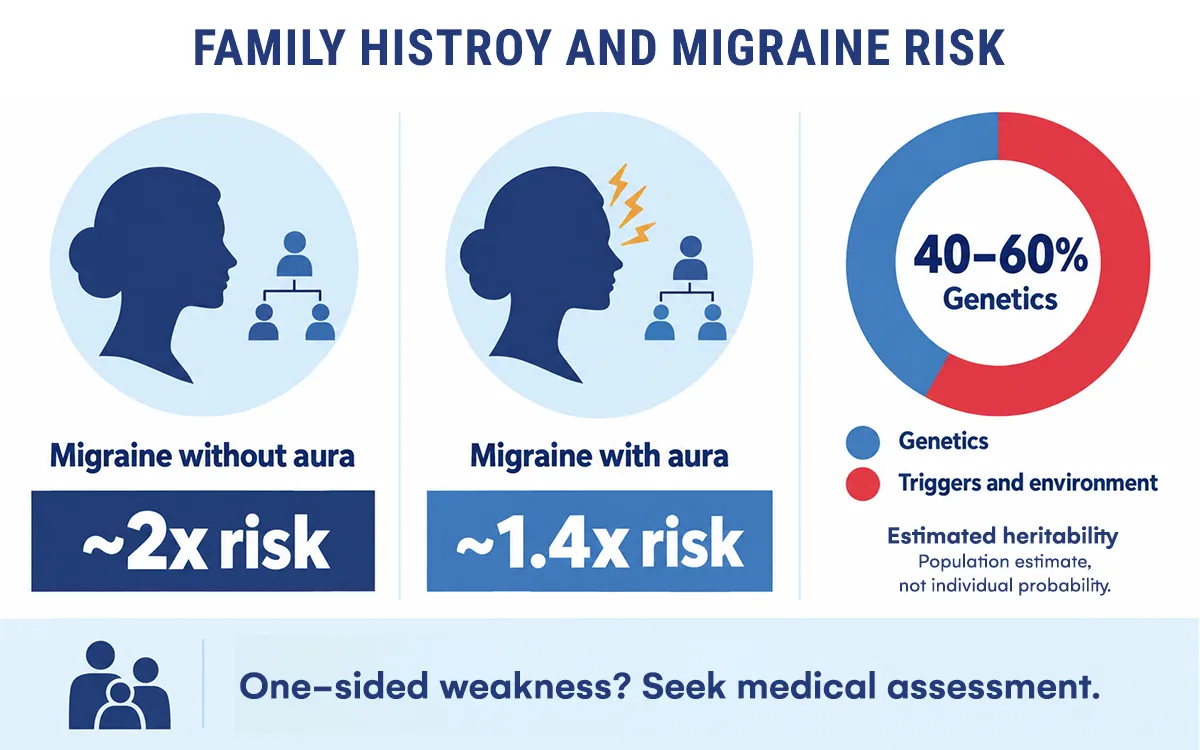
Chart showing how a family history of migraine raises your risk and how much migraine is genetic, about 40 to 60 percent.

Migraine isn’t a minor inconvenience in India. It’s a leading cause of lost workdays and reduced quality of life. 

  • India’s one-year migraine prevalence is estimated at 25%, well above the global average of 14.7%. 
  • Migraine is believed to affect over 213 million people in India. 
  • One large study reported 31.6% prevalence in women versus 18.5% in men. 
  • Prevalence peaks between ages 35 and 45, prime working years for most people. 
  • Community studies show a loss of roughly 6% of productive days per person annually. 

Despite this scale, migraine remains underdiagnosed, often dismissed as “just stress” or “just a headache” rather than treated as the recognised neurological condition it is.

If your week involves back-to-back screens, inconsistent meals and sleep that shifts with deadlines, you’re stacking triggers on top of whatever genetic sensitivity you were born with. 

  • Irregular sleep: both too little sleep and sudden schedule changes are well-documented triggers. 
  • Skipped meals and dehydration: long meetings mean delayed eating and forgotten water. 
  • Screen strain: prolonged exposure with poor lighting or no breaks is commonly reported. 
  • Caffeine swings: too much, or sudden withdrawal, can trigger attacks, and how your body processes caffeine is itself partly genetic. 
  • Chronic stress: it affects the same neurological pathways involved in migraine attacks, not just your mood. 

Two colleagues with similar workloads and family history can have very different patterns, because their genes affect how sensitive they are to these specific triggers.

In most cases, yes. Genetic sensitivity sets your baseline, but identifying and managing your personal triggers has consistently been shown to reduce attack frequency and severity, even with a strong family history. 

The challenge is that trigger lists online are generic: avoid caffeine, cheese, wine. In reality, specific genes affect how your body processes these exact substances, which is why “avoid chocolate and caffeine” helps some people enormously and does nothing for others. 

Is Migraine Genetic Hereditary Advice Enough? Where Generic Trigger Lists Fall Short 

Knowing that migraine is genetic and runs in families is only the first step. A few genes known to influence trigger sensitivity show why: 

  • MTHFR: affects folate metabolism and has been linked to migraine with aura. Some people benefit from targeted B-vitamin support, others don’t. 
  • CYP1A2: determines how quickly you metabolise caffeine. Slow metabolisers are more likely to find caffeine a trigger rather than a relief. 
  • TRPM6: involved in magnesium regulation, relevant since magnesium deficiency is a known contributor to migraine frequency. 
  • DAO-related genes: affect how efficiently you break down histamine, which matters for migraines triggered by aged cheese, wine or fermented foods. 

A generic list ignores all of this. A genetic profile can narrow it down to what’s relevant for your body. 
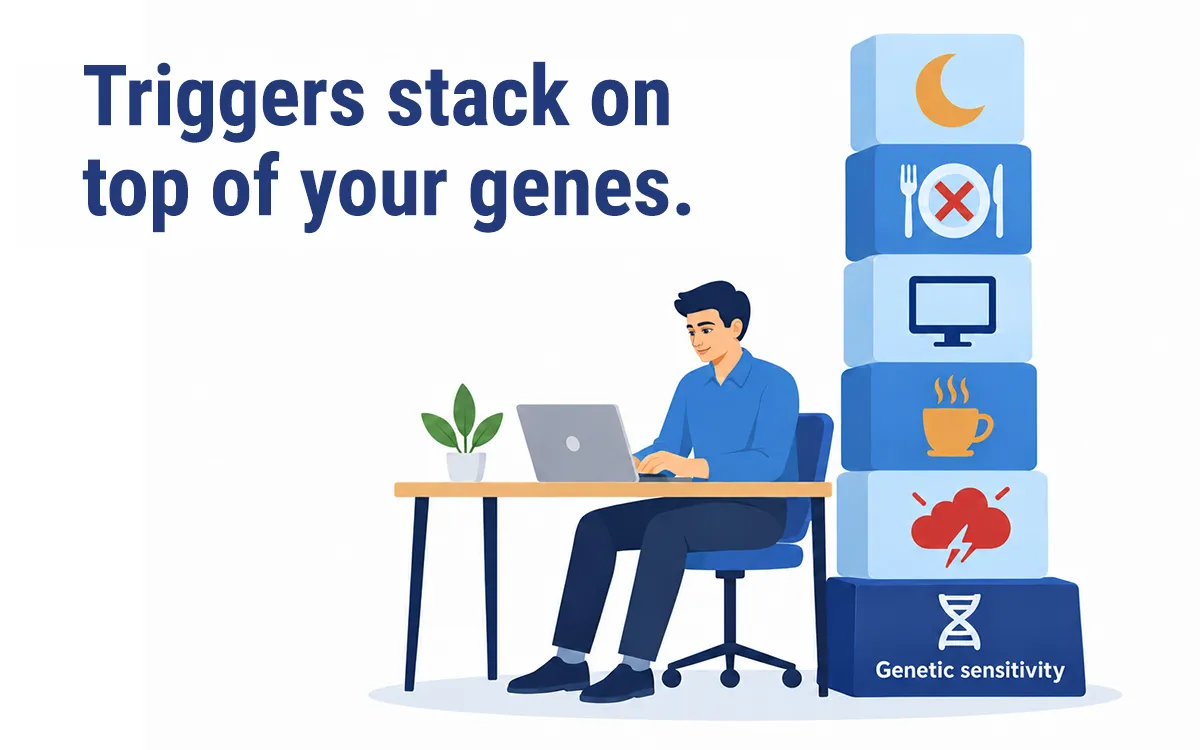
Trigger stacking illustration

A genetic report is built from the one thing unique to you: your own DNA. Say your report shows a slow-metabolising CYP1A2 variant. Instead of a vague “limit caffeine,” your plan can give you an actual cutoff and a suggested time of day to stop. If a DAO variant is flagged, your plan can point to aged cheese, cured meats, wine and fermented foods as priorities, instead of a generic “avoid these 40 foods” list. If magnesium-related genes show a likely gap, your plan can recommend food sources or supplementation matched to that gap, not a flat one-size-fits-all dose. 

Instead of trying every tip online and tracking months of headaches to see what sticks, your genetic profile tells you where to start. It works alongside whatever your neurologist has prescribed and doesn’t replace it. 

What’s inside the report: 

  • Caffeine sensitivity: whether your CYP1A2 profile makes you a fast or slow metaboliser, and what that means for daily intake. 
  • Histamine tolerance: your genetic likelihood of reacting to histamine-rich foods. 
  • Nutrient gaps: genetic indicators for magnesium, riboflavin (B2) and folate-related pathways. 
  • Polygenic migraine risk score: where your overall sensitivity sits compared to the general population. 
  • A prioritised action list: the two or three areas most worth changing first. 

The real value isn’t the test itself. It’s what it tells you about your own body that no symptom diary or generic article could. Two people can have identical migraine frequency and completely different genetic reasons behind it: caffeine timing for one, histamine-rich dinners for another, a magnesium gap for a third. 

Unlike a headache diary, a genetic test is done once. Your DNA doesn’t change, so a single test gives you a lasting reference, through the next pregnancy, the next job change and the next year.

Understand Your Personal Triggers, Not Just the Generic List 

Maybe migraine runs in your family. Maybe years of screens, skipped meals and shifting sleep have made it worse. Either way, knowing which triggers your body is genetically sensitive to is far more useful than another generic list everyone’s already tried. 

A Lifecode genetic test reads that once. Your nutrition and lifestyle plan is then built around your own report, guided by real health experts throughout. 

Reference

    • Kulkarni GB, Rao GN, Gururaj G, Stovner LJ, Steiner TJ. Headache disorders and public ill-health in India: prevalence estimates in Karnataka State. The Journal of Headache and Pain. https://link.springer.com/article/10.1186/s10194-015-0549-x
    • Hautakangas H, Winsvold BS, Ruotsalainen SE, et al. Genome-wide analysis of 102,084 migraine cases identifies 123 risk loci and subtype-specific risk alleles. Nature Genetics. https://www.nature.com/articles/s41588-021-00990-0

Medical Disclaimer

This article is for general information and awareness only. It is not medical advice, and it is not a diagnosis or a substitute for professional care. Migraine is a medical condition, and symptoms such as frequent or severe headaches, headaches that change in pattern, one-sided weakness, vision or speech changes, confusion, or a sudden severe headache need prompt evaluation by a qualified doctor or neurologist. Do not start, stop or change any medication or supplement based on this article. Genetic test results show tendencies, not certainties. They do not diagnose migraine or predict whether you will develop it, and they should be interpreted alongside your medical history and the advice of your healthcare provider. A Lifecode nutrition and lifestyle plan is designed to complement, not replace, treatment prescribed by your doctor. If you think you may be having a medical emergency, contact your local emergency services immediately.doctor, genetic counsellor, or oncology dietitian. A genetic test cannot diagnose cancer or predict whether you will get it, and it does not replace screening or treatment. If you have symptoms, see a doctor promptly.

FAQ

Frequently Asked Questions

Yes, to a significant degree. Twin studies estimate 40 to 60% heritability, though for most people it’s a combination of many genes rather than one, so genetics sets sensitivity rather than guaranteeing migraines. 

Yes, in the sense that inherited variations shape your sensitivity. It doesn’t follow a simple inheritance pattern for most people. 

Common migraine is genetic but not strictly hereditary. It clusters in families without a predictable pattern. The rare exception is familial hemiplegic migraine, caused by a single gene with a 50% chance of passing to each child. 

Chronic migraine builds on the same underlying genetic sensitivity, with triggers and lifestyle playing a large role in how often attacks occur. A neurologist can assess your specific type. 

Not necessarily, but your risk is higher, roughly double for migraine without aura. Triggers and lifestyle still play a large role in whether that risk becomes actual migraines. 

October 9, 2026 Uncategorized
Last Updated On October 09, 2026