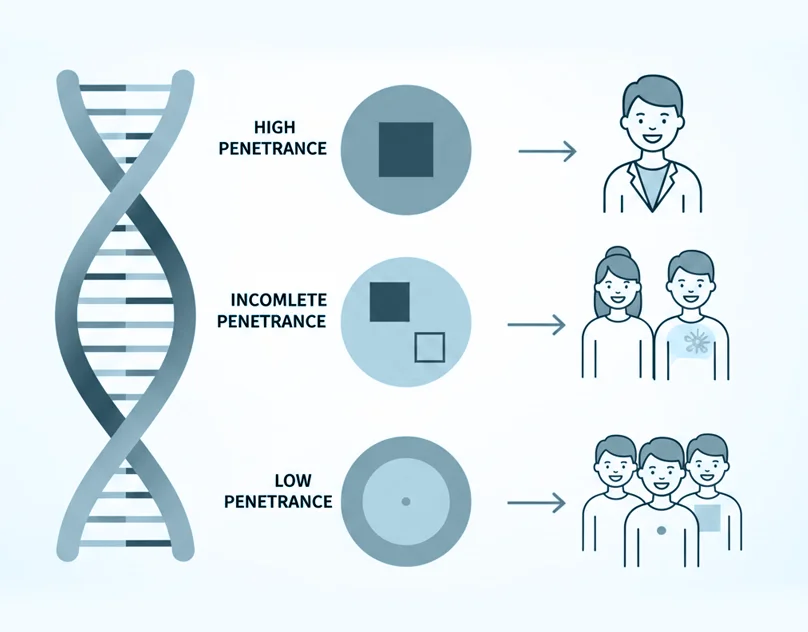
Understanding your DNA can feel like learning a new language. When you receive genetic results, you might see the term “genetic penetrance.” It sounds complicated, but it is a vital concept for understanding how your genes affect your health.
What is Genetic Penetrance?
According to research, penetrance is “the proportion of individuals carrying a particular variant of a gene that also express an associated trait.”
Think of your DNA like a light switch. In some cases, if the switch is “on” (meaning you have the gene), the light (the trait or disease) always shines. In other cases, the switch might be on, but the light stays dim or even dark.
Two Main Types of Penetrance:
Complete Penetrance: If you have the gene mutation, you will definitely show the trait. A well-known example is Huntington’s disease. If a person inherits the specific mutated gene for Huntington’s, they will eventually develop the condition.
Incomplete (Reduced) Penetrance: Some people carry the gene mutation but never show any signs of the disorder. This can make it tricky for doctors to predict who will get sick.
Why Doesn't Everyone Get the Disease?
You might wonder why two people with the exact same genetic mutation have different health outcomes. This happens because our bodies are complex. Several factors can “dampen” or “strengthen” the effect of a gene:
Other Genes: Sometimes, other “modifier genes” act like a shield, protecting you from the harmful effects of a mutation.
Environment: Your lifestyle, diet, and exposure to toxins can influence whether a gene “activates.”
Age: Some conditions have age-related penetrance. This means the symptoms don’t show up until you get older.
Real-World Examples and Statistics
Understanding the numbers can help lower anxiety and provide a clearer picture of health risks.
BRCA1 and BRCA2: These are genes linked to breast and ovarian cancer. However, having the mutation does not mean a cancer diagnosis is certain. Studies show that the penetrance for breast cancer in women with a BRCA1 mutation is about 72% by age 80.
Retinoblastoma: This is a rare eye cancer. The penetrance for the specific gene mutation is about 90%. This means 10% of people with the gene will never develop the cancer.
Polydactyly: It is often cited as a classic example of incomplete penetrance, as some family members carry the gene but have the standard five fingers.
The Role of Genetic Testing
Genetic testing is the most powerful tool we have to identify these risks. While a test cannot always tell you exactly what will happen, it provides a roadmap for your healthcare.
Why get tested?
Risk Assessment: It helps you understand if you carry a gene with high or low penetrance.
Early Prevention: If you know you have a high-penetrance gene for a condition like colon cancer, you can start screenings much earlier.
Family Planning: Knowing your genetic makeup helps you understand the chances of passing certain traits to your children.
Testing isn’t just about finding “bad news.” It’s about empowerment. When you have the data, you and your doctor can make a plan to monitor your health proactively.
Take Control of Your Health with Lifecode
Navigating the world of genetics can be overwhelming, but you don’t have to do it alone. At Lifecode, we provide the clarity you need to understand your unique biological blueprint.
Our Lifecode Panel Advanced Genetic Testing goes beyond basic ancestry. We look deep into your DNA to provide actionable insights about your health, risks, and the penetrance of specific markers.
Ready to get started?
Whether you are curious about your family history or want to take a proactive step in your wellness journey, we are here to help.
Order a Genetic Testing Kit: Our simple, non-invasive swab test can be done from the comfort of your home.
Book a Genetic Consultation: Speak with an expert who can walk you through your results and explain what they mean for your future.