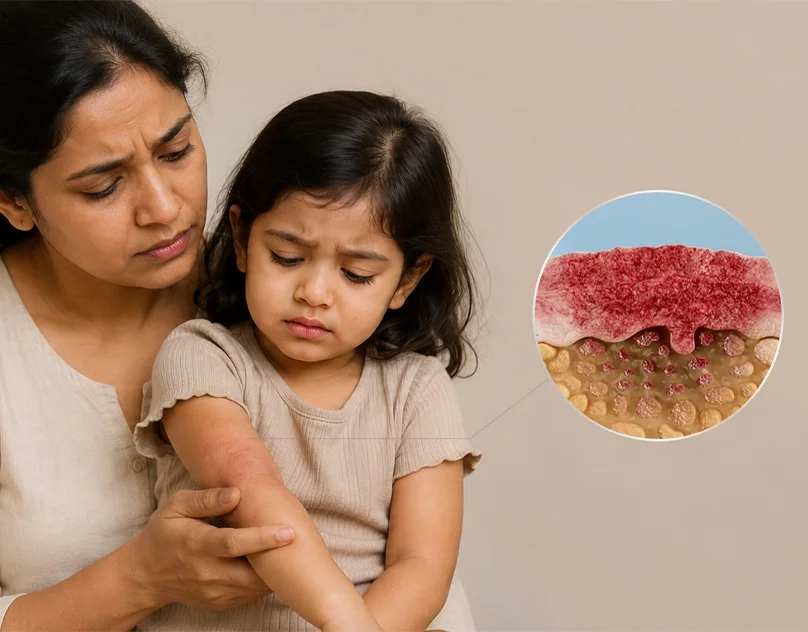
You’ve cleared out the pantry, replaced the dairy with oat milk, and swapped your laundry detergent for the third time this month. You’ve scrubbed every surface, banned the cat from the bedroom, and bought enough fragrance-free moisturizer to fill a bathtub. For a week, your child’s skin looks clear—and then, seemingly out of nowhere, the redness, the scaling, and the midnight scratching return.
It feels like a personal failure. You scan the room, wondering: Did I miss a dust mite? Was there hidden soy in those crackers?
But here is the truth that might finally let you breathe: Sometimes, external triggers matter less than the internal blueprint. If your child eczema keeps coming back genetic reason factors are likely the silent drivers behind the flare-ups, regardless of how many “obvious” triggers you eliminate.
The "Leaky Bucket" Paradox: Why Avoidance Isn't Enough
Most parents approach skin flares like a game of Whack-A-Mole. You hit one trigger (dust), and another pops up (pollen). This cycle is exhausting because it assumes the skin is a passive surface that only reacts to what touches it.
In reality, think of your child’s skin like a bucket. Most advice focuses on stopping the “water” (triggers) from pouring in. But if the bucket has holes in the bottom, it doesn’t matter how much you control the flow—the system remains unstable. When a child eczema keeps coming back genetic reason is usually found in how that “bucket” was built.
The FLG Factor: A Missing "Mortar" in the Skin Barrier
One of the most significant breakthroughs in pediatric skin health is the study of the FLG gene eczema child India researchers and global scientists have highlighted.
The FLG gene is responsible for producing a protein called filaggrin. Think of filaggrin as the “mortar” between the “bricks” (skin cells). Its job is to:
Keep moisture locked inside.
Keep environmental irritants and allergens locked out.
When there is a variation in the FLG gene, the body doesn’t produce enough filaggrin. This leads to skin barrier genetics child issues where the barrier is naturally “leaky.” Even in a sterile environment, moisture evaporates too quickly (transepidermal water loss), and the skin becomes dry and cracked. This creates a direct pathway for even the tiniest particles to enter the deeper layers of the skin, triggering an alarm before you even realize a “trigger” was present.
The Overactive Alarm: IL-4 and IL-13 Variants
If the FLG gene is about the “wall,” the immune response eczema genetics are about the “security guards” inside the wall.
Even if the skin barrier is slightly compromised, a flare-up only happens when the immune system decides to overreact. This is where genes like IL-4 and IL-13 come into play. These genes influence how the body handles inflammation. In many children with persistent skin issues, these genetic pathways are set to “high sensitivity.”
When the child eczema keeps coming back genetic reason is often that the immune system is stuck in a pro-inflammatory loop. Instead of a mild reaction to a change in weather, these genetic variants cause the body to launch a full-scale inflammatory response. This is why you might see a flare-up during a period of stress or a minor cold—the immune system is already “primed” to react, making it look like an external trigger was the culprit when it was actually an internal shift.
Why "Trigger Hunting" Can Sometimes Lead You Astray
We are taught that if we find the “cause,” we can stop the effect. However, focusing solely on an avoidance list can lead to:
Nutritional Gaps: Cutting out entire food groups unnecessarily.
Parental Burnout: Feeling constant guilt that you haven’t “cleaned well enough.”
Missed Support: Ignoring the need to proactively build the skin barrier because you are too busy trying to find the next allergen.
Understanding the child eczema genetic cause allows you to shift from a defensive mindset (hiding from the world) to an offensive mindset (fortifying your child’s unique biology).
Traditional Approach
Genetic-Informed Approach
Focuses on removing 100% of triggers.
Focuses on strengthening the skin barrier 100% of the time.
Reacts only when a flare-up occurs.
Proactively manages inflammatory tendencies.
Assumes all children react the same way.
Acknowledges that skin barrier genetics child differ.
High stress, trial-and-error “elimination” diets.
Targeted support based on known biological predispositions.
Navigating the Indian Context: Environment vs. Biology
In India, we face unique environmental challenges—high humidity, urban pollution, and seasonal dust. These are often blamed entirely for skin issues. However, when we look at FLG gene eczema child India specific data, we see that genetic predispositions make certain children significantly more susceptible to these environmental factors than others.
While you cannot change the air quality in your city, knowing your child has a child eczema genetic cause related to barrier function means you can prioritize specific types of emollient therapy that mimic missing filaggrin, rather than just guessing which “natural” remedy might work.
Moving Beyond the Itch: A New Framework for Parents
When you realize your child eczema keeps coming back genetic reason is the core driver, the way you look at their skin changes. You stop asking “What did they touch?” and start asking “How can I support their skin barrier today?”
This isn’t about a clinical diagnosis; it’s about understanding inflammation markers and immune response clusters. It’s about knowing if your child’s body has a natural tendency toward a more aggressive inflammatory response.
What genetic insights can reveal:
Barrier Integrity: Does your child need extra support with specific lipids or ceramics?
Inflammatory Pathways: Is their immune system naturally “loud,” requiring more focus on soothing internal inflammation?
Antioxidant Support: How well does their skin handle oxidative stress from urban pollution?
Knowledge is the Best Barrier
If you are tired of the “flare-clear-flare” cycle, it may be time to stop looking under the bed for triggers and start looking at the blueprint. Understanding why a child eczema not going away is often a matter of DNA, not just detergent, can be the most empowering shift a parent can make.
By identifying immune response eczema genetics, you move away from the frustration of the unknown and toward a lifestyle that supports your child’s specific needs. You can’t change their genes, but you can change how you care for them.
Take the Next Step for Your Child's Comfort
Stop the guesswork and start understanding the “why” behind the itch. By exploring the underlying genetic tendencies of your child’s skin and immune system, you can provide the targeted support they truly need.