

Is Autism Genetic? What Indian Families Should Know
Is Autism Genetic?
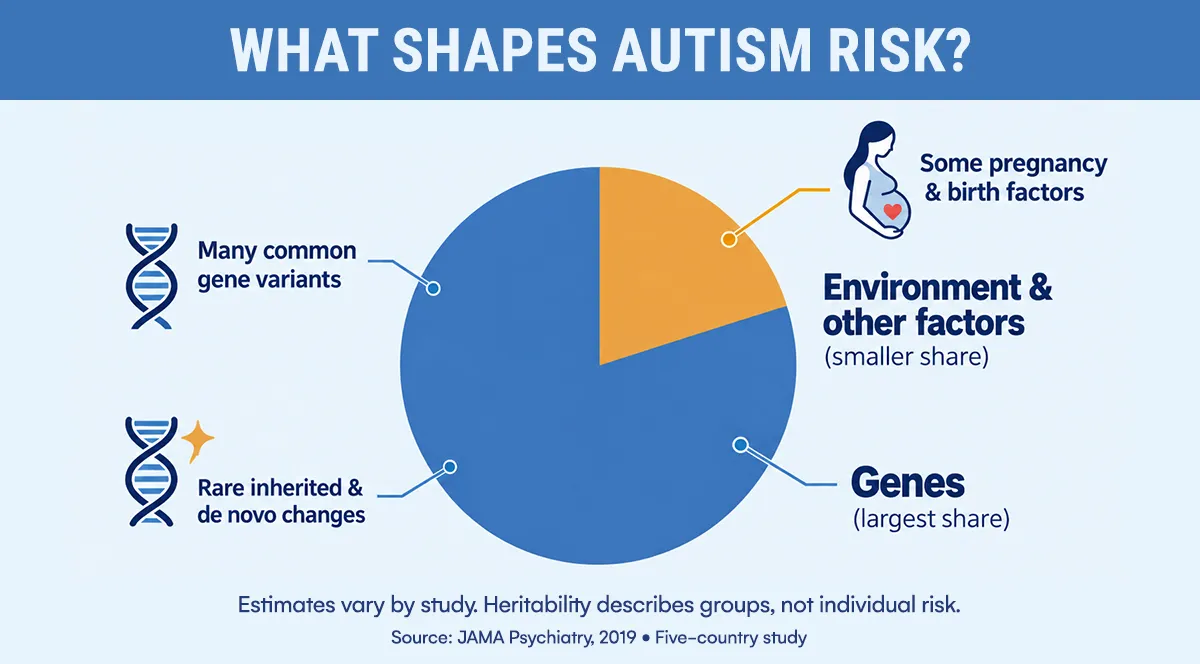
Yes, autism is mostly genetic. Large studies estimate that genes explain about 80% of autism risk across a population. No single gene causes it. Hundreds to thousands of genes each add a small part, and together they shape how the brain develops before birth.
Other factors play a smaller role. These include some infections during pregnancy and some birth complications. They usually work alongside a child’s genes and rarely act alone. Autism is not caused by parenting, by what a mother ate, or by anything a parent did or did not do.
This is why autism often runs in families. A child gets half their DNA from each parent, so autism-related genes can come from either side. Some children also have new genetic changes that neither parent carries. These changes appear for the first time in children.
If your child was just diagnosed, or autism runs in your family, the sections below cover how genes, family history, testing, and other factors fit together.
Is Autism a Genetic Disorder or Disease?
Autism has a strong genetic basis, but doctors call it a neurodevelopmental condition, not a genetic disease. It affects how the brain develops, starting before birth, and it lasts for life. Signs usually show up in the first few years, such as late speech, little eye contact or strong reactions to change.
Many doctors avoid the words “disease” and “disorder” for two reasons. A disease usually comes and goes, and autism does not. Autism is also part of how a person’s brain works. It brings real challenges for some people and real strengths for others, and the level of support needed differs a lot from one person to the next.
Autism is also not a single-gene condition like cystic fibrosis. Some genetic syndromes, such as fragile X syndrome, can come with autism. In most cases, though, many genes combine to raise the chance. That is why a genetic test cannot diagnose autism or predict it. Doctors diagnose it by studying a child’s development and behavior.
Quick facts:
- A large study of children in five countries put autism heritability at about 80%.
- There is no single “autism gene.” Hundreds to thousands of genes are linked to it.
- A genetic test cannot diagnose autism or predict it. Doctors diagnose it by studying development and behavior.
- Parenting, and what a mother ate or did in pregnancy, do not cause autism.
How Common Is Autism in India?
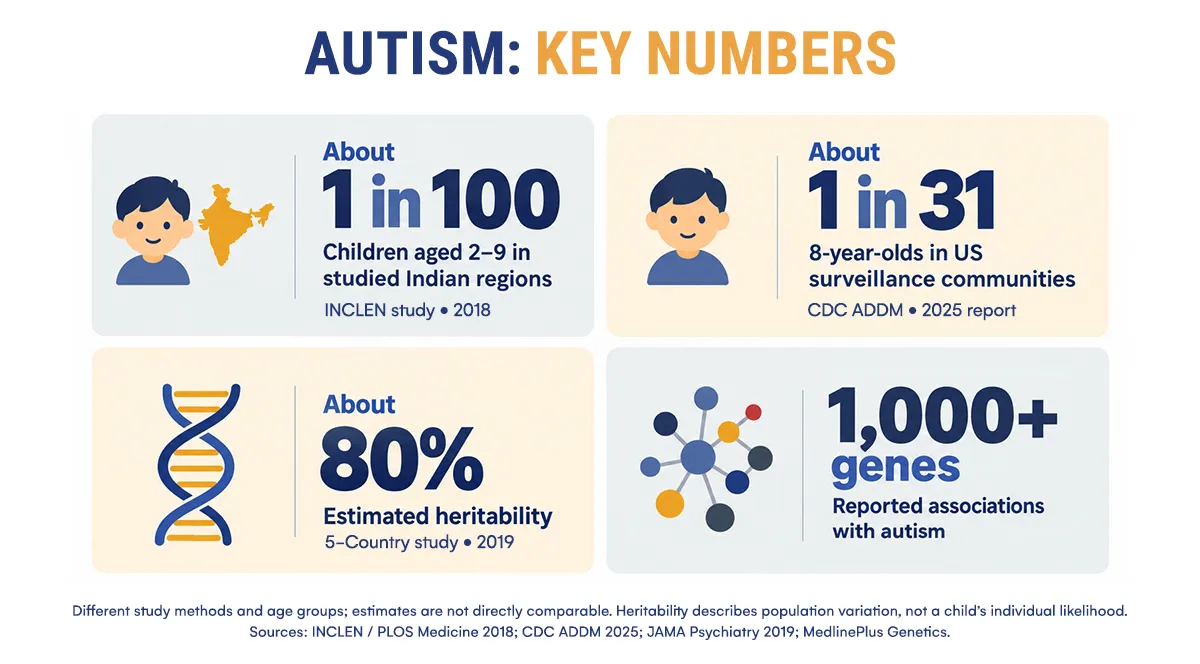
India has no national autism count, so the numbers come from studies. The best-known one, led by the INCLEN Trust and published in PLOS Medicine in 2018, checked nearly 4,000 children aged 2 to 9 in both city and rural areas. It found that about 1 in 100 children under 10 had autism. Rates in different areas ranged from 0.4% in North Goa to 1.8% in Palwal, Haryana.
For comparison, the latest CDC report (April 2025) found about 1 in 31 eight-year-olds in the U.S. identified with autism, up from 1 in 36 in 2020. Experts link the rise mostly to more awareness, wider diagnosis criteria and better screening. The numbers are not directly comparable, because the studies used different methods.
What Percentage of Autism Is Genetic?
The honest answer is a range. Researchers measure heritability, which shows how much of the difference in autism across a population links to genes. It does not give the chance for one child.
- A 2019 study in Denmark, Finland, Sweden, Israel and Western Australia estimated heritability at about 80%.
- Earlier twin studies reported 80% to 90%.
- A 2014 Swedish study first estimated about 50%. The same group later re-analyzed its data and arrived at about 83%.
- A small California twin study found a lower figure, around 37%.
Most large studies agree on the main point: genes account for most of the risk, and shared family environment adds little.
Is Autism Genetic or Environmental?
Both, but not in equal parts. Genes carry most of the weight. Environmental factors seem to play a smaller role and usually work together with genes.
Genetic factors:
- Common gene variations. Many small variants, each adding a tiny bit of risk.
- Rare inherited variants passed down from a parent.
- De novo (new) changes. This appears for the first time in the child. A newborn has about 40 to 80 new single-letter DNA changes. Most do nothing, but a few can affect brain development.
- Genetic syndromes, such as fragile X syndrome, that can come with autism.
Other factors under study: some infections in pregnancy, such as rubella, and some birth complications. Researchers are careful here, because a link is not always a cause. Large studies have not found vaccines to cause autism.
Is autism genetic or developmental?
Both words are right. “Genetic” explains why it happens. “Developmental” explains when: the brain develops differently from before birth, and signs show up in the first few years.
Is Autism Hereditary or Genetic? From Mother or Father?
Hereditary means passed from parent to child. Genetic means related to genes in any way, including new changes that neither parent carries. Autism can be either, and often both.
A child gets half their DNA from each parent, so autism-related variants can come from either side. One study of autistic siblings found that over half of the shared new mutations seemed to come from the father’s side. That is a finding about DNA, not a reason to blame anyone. Nobody picks the genes they pass on.
If One Child Has Autism, What Is the Chance for Another?
In the large Swedish study, a child with an autistic full sibling was about 10 times more likely to be autistic than the general population. The chance was about 3 times higher with a half-sibling and 2 times higher with a cousin. Studies that follow younger siblings report recurrence of roughly 6% to 10%, sometimes higher. Most younger siblings are not autistic.
A Nature Medicine study found that nearly 70% of autistic children carried risk variants that differed from their autistic siblings. Even siblings can take different genetic routes to autism.
Cousin marriage: In some communities in India, marriage between relatives is common. It raises the chance of rare recessive genetic conditions, and some of these come with autism. If you plan a pregnancy or already have a child with autism or developmental delay, a clinical geneticist or genetic counselor can look at your family tree and advise you.
Can a Genetic Test Show Autism in India?
No test can say “this child is autistic.” But testing can still help. Globally, tests find a specific cause in about 15% of autistic children.
An Indian study published in BMC Neurology in 2023 tested 101 autistic children and both parents. Chromosomal microarray found a genetic diagnosis in about 3% of children. Whole exome sequencing, which reads the protein-coding part of DNA, found one in about 30%. The authors suggested exome sequencing as a first test in India. It was a small study, so ask your doctor which test fits your child.
Results can help a family:
- Find out whether a known genetic syndrome is involved
- Watch for related needs, such as seizures or sleep problems
- Understand the recurrence chance for a future pregnancy
A “normal” result does not rule out genetics. It only means today’s tests did not find the cause. Costs differ by lab and test, so ask for a written quote, and ask whether your insurer or a government hospital offers the test.
Diet, Recovery and Support: What Helps?
Parents often ask about diet and “recovery” right after hearing that autism is genetic. A few clear points:
Autism is not an illness a child recovers from. It is a lifelong difference in brain development. No diet, supplements, herbal products or procedure can change the genes behind it. Be careful with any clinic, app or social media page that promises a “cure,” and offers of stem cell therapy, chelation or “detox” for autism. These are not backed by good research, and some carry real risks.
What support can do is help child build skills, feel comfortable and manage daily life. Many children make gains in communication, learning and independence with the right help over time. Progress differs for each child.
Where diet fits in:
- Many autistic children are picky eaters or dislike certain textures. Parents often find a child will only eat a few foods, such as plain rice, roti or biscuits. A pediatric dietitian can help widen the plate slowly and check for gaps.
- If the family is vegetarian, ask the doctor whether to check vitamin B12, iron and vitamin D levels. Dal, curd, paneer, eggs (if eaten), nuts, seeds and leafy vegetables can all help, depending on what the child accepts.
- Constipation and stomach pain are common and worth treating with a doctor’s guidance.
- Gluten-free and casein-free diets are popular, but research does not show strong benefit for autism. Removing wheat or milk from a growing child’s diet can cause nutrition gaps.
- Speak with your child’s doctor or a registered dietitian before removing foods or adding supplements.
Getting Support in India
You do not have to wait for a private diagnosis to begin.
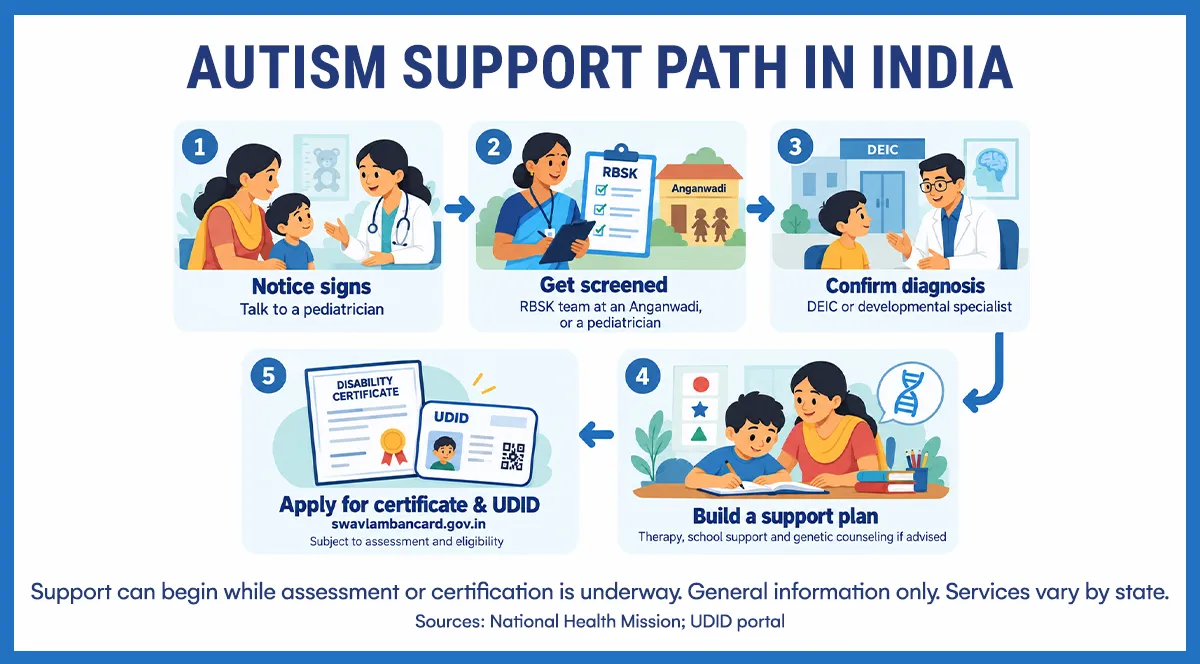
- Screening: Under the government’s Rashtriya Bal Swasthya Karyakram (RBSK), children from birth to 18 are screened for defects, diseases, deficiencies and developmental delays. Autism is listed in the programme. Mobile health teams and Anganwadi centres refer children to the District Early Intervention Centre (DEIC), where a diagnosis is confirmed.
- Evaluation: A developmental pediatrician, child psychiatrist or child psychologist can assess your child.
- Therapy: Speech, occupational and behavioral therapy, plus special education, are commonly used. Start with the team’s advice on what fits your child.
- Disability certificate and UDID: Autism is covered under the Rights of Persons with Disabilities (RPWD) Act, 2016. You can apply for the disability certificate and Unique Disability ID (UDID) card at swavlambancard.gov.in. You will need ID proof, address proof, a photo and a medical assessment at a government hospital. The card can help with schemes, concessions, school and exam accommodations.
Common Myths About Autism in India
- Myth: Autism comes from bad parenting or the mother’s mistakes. Research does not support this. Genes drive most of the risk.
- Myth: It is caused by bad luck, evil eye or something done in a past life. There is no evidence for this.
- Myth: There is one autism gene. There are many.
- Myth: A genetic test can diagnose autism. Diagnosis comes from a developmental evaluation.
- Myth: Diet or detox can reverse autism. No diet changes the genes behind autism.
When to Talk to a Doctor
See a pediatrician or developmental specialist if your child:
- Does not respond to their name by about 12 months
- Does not point, wave or make eye contact
- Loses words or skills they had before
- Is behind in speech or play compared with other children their age
- Gets very upset by small changes, or repeats movements or phrases often
Early screening does not put a label on a child. It opens the door to support sooner. If autism runs in your family, mention it at checkups.
Disclaimer
This article is general information. It is not medical advice and does not replace an exam by a qualified health professional.
Sources
- CDC ADDM Network, MMWR, April 2025: CDC MMWR report
- National Health Mission, RBSK operational guidelines: RBSK 2.0 Operational Guidelines 2026 (NHM) | DEIC guidelines
- ASAT, “Autism Recurrence in Families”: ASAT page