


Is Vitiligo Genetic? Your Genes Matter, But They Don’t Decide Everything


Yes, genes play a big part in vitiligo. But genes are not destiny. Most people with a family history never get white patches, and some people with no family history do. A gene test can show your risk early, so you can plan instead of worrying.
What is vitiligo?
Vitiligo is a skin condition where the cells that give skin its colour (melanocytes) stop working. White patches appear on the skin. It is not an infection. It does not spread by touch. It is an autoimmune condition, which means the body’s own defence system attacks these colour cells by mistake.
In India, vitiligo is common, and it often comes with stigma. A large study across 30 medical colleges in 21 states checked more than 4.4 lakh skin OPD patients. It found vitiligo in about 0.89% of them, slightly more in women (0.93%) than in men (0.86%). Other Indian surveys put the figure between 0.6% and 1.13% of the population, and some pockets of Gujarat and Rajasthan report much higher numbers.
So, is vitiligo genetic?
Mostly, yes, but not in the simple way people expect. It does not pass from parent to child like eye colour. It is a “polygenic” condition. This means many small gene changes add up. Researchers have found more than 50 gene regions linked to vitiligo risk. Many of them control the immune system or the colour cells.
Here is what the numbers say:
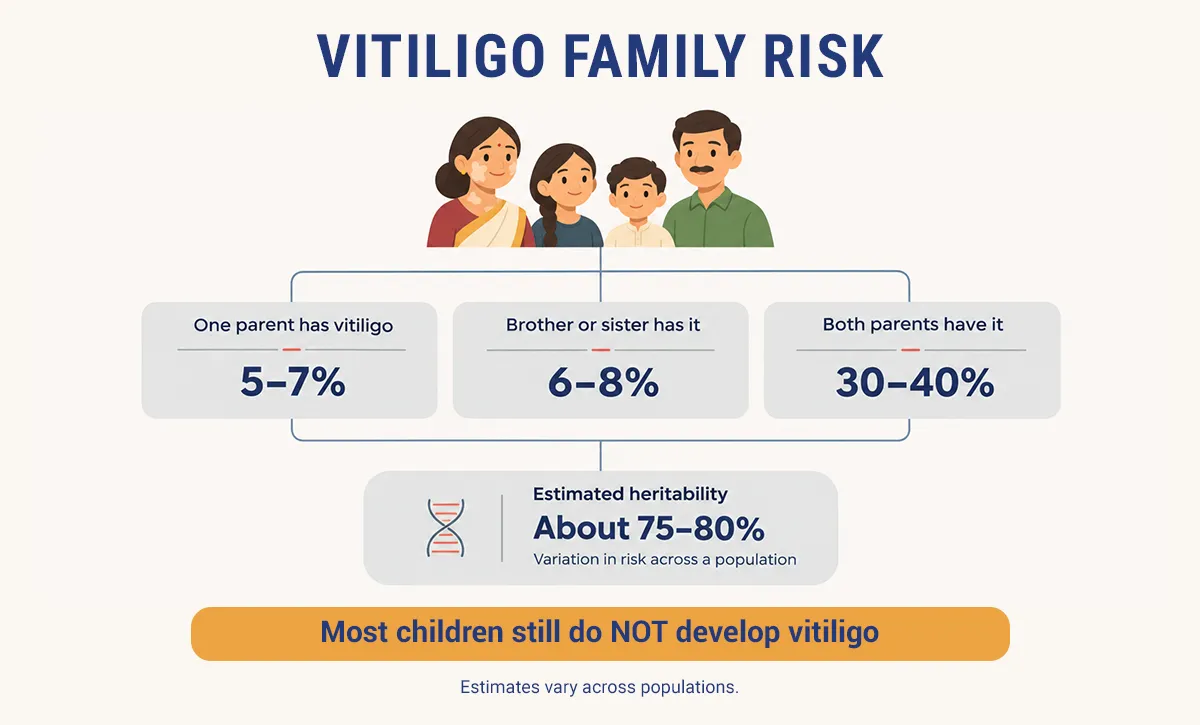
Heritability is high. Twin and family studies estimate that about 75% to 80% of vitiligo risk comes from genes.
If one parent has vitiligo, A child’s risk is about 5–7%.
If a brother or sister has it, the risk is about 6–8%.
If both parents have it, the risk rises to about 30–40%.
Around 30% of people with vitiligo report a family member with the same problem.
Look at these numbers once more. Even with both parents affected, more than half of the children do not get vitiligo. That is the first sign that genes are only one part of the story.
Why genes are not destiny
Identical twins share the same DNA. Yet if one twin has vitiligo, the other does not always get it. So something else must switch the condition on. Doctors call these “triggers.”
Common triggers include:
Long-term mental stress
Skin injury, such as cuts, burns, or constant rubbing
Heavy sun exposure and sunburn
Contact with certain chemicals or skin-whitening products
Other autoimmune problems, especially thyroid disease
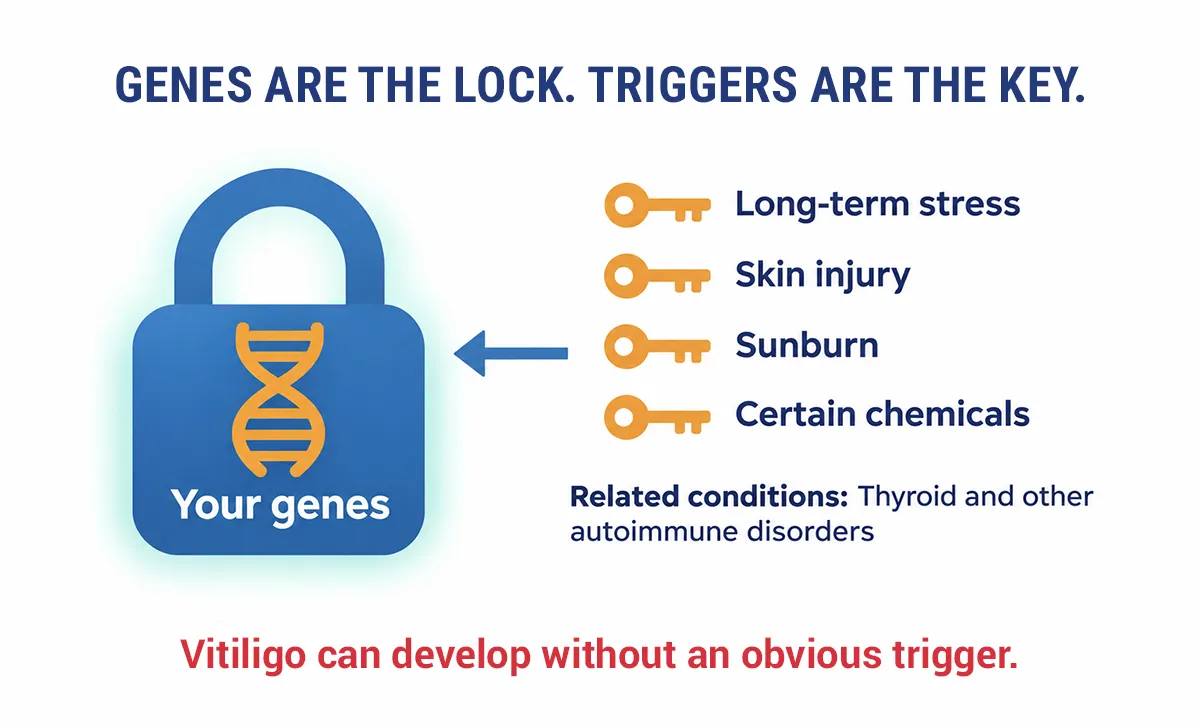
Think of it like a lock and a key. Your genes may be the lock. A trigger is the key. Without the key, the lock stays shut for many people.
Who should pay more attention?
Look at your own family and check for these points:
A parent, sibling, or grandparent with vitiligo
Thyroid disease, type 1 diabetes, or other autoimmune problems in the family
Marriage between close relatives (the Indian nationwide study found family history, consanguinity, and thyroid problems were all more common among people with vitiligo)
White patches that started before age 20 (this happened in over 46% of the Indian patients studied)
If two or more of these points match your family, it is worth getting a proper check.
Diet and recovery: what is real and what is not
Many families ask, “Which food causes vitiligo?” Honest answer: no single food has been proven to cause it or cure it. Reviews of diet and vitiligo found only a small number of good studies, so doctors stay careful.
What the research does suggest:
Vitamin D: Many people with vitiligo have low levels. Get your level tested. Take a supplement only if you are low, and only in the dose your doctor gives. Too much vitamin D can be harmful.
Antioxidants: Vitamin C, vitamin E, and alpha-lipoic acid have shown some benefit when taken along with light therapy (NB-UVB). The proof is still limited.
Colourful food: Fruits, vegetables, dals, nuts, and amla are a sensible choice. They are good for your general health and may ease stress on the skin cells.
Less fried and fatty food: A diet high in saturated fat has been linked to higher risk and severity in some studies.
Gluten-free diet: Helps only if you also have celiac disease. Otherwise, there is no strong proof.
For recovery, treatment still matters most. Doctors use creams, light therapy, and newer medicines. Early treatment usually gives better results. Diet is a helper, not a replacement.
Why take a genetic test once?
Here is the useful part. You cannot change your genes. But you can know them early.
A genetic test looks at your DNA for variants linked to autoimmune and skin-related risks. It cannot say “you will get vitiligo” or “you will not.” Only a skin doctor can diagnose vitiligo by examining you. What a test can do is give you a clearer picture of your family risk, once, for life. Your genes do not change, so you do not need to repeat it.
With that picture, you can:
Watch early. Notice a new pale spot quickly and see a dermatologist before it grows.
Protect your skin. Avoid sunburn, repeated skin injury, and harsh products.
Check your thyroid. Vitiligo and thyroid problems often travel together.
Plan food and lifestyle. Build a routine around your own risk, not a generic diet chart.
Guide the family. Parents, siblings, and children can make informed decisions together.
Knowing your risk does not mean you will get the condition. It means you stop guessing.
What you can do this week
Ask your parents and grandparents about vitiligo, thyroid disease, or other autoimmune problems.
Check your skin once a month in good light, including elbows, knees, hands, and around the mouth.
Get vitamin D and thyroid levels tested if you have a family history.
Protect your skin from sunburn and injury.
Consider a one-time genetic test to understand your inherited risk, and discuss the result with a doctor.
If you want to understand your own family risk, Lifecode’s genetic testing can be a simple first step.
Sources
Spritz RA, Santorico SA. The Genetic Basis of Vitiligo. (Environmental share of risk and role of triggers.)
Dutta RR, et al. Diet and Vitiligo: The Story So Far. Cureus, 2022. (Vitamin D and supplement evidence.)
Clinical profile of vitiligo with associated cofactors. (Indian prevalence range and the higher figures in Gujarat and Rajasthan.)
A nationwide, multicentric case-control study on vitiligo (MEDEC-V). Indian Journal of Dermatology, 2020;65(6):473-482. (Covers 4.4 lakh OPD patients, 30 colleges, 21 states, 0.89% prevalence, women 0.93% vs men 0.86%, onset before age 20 in over 46%, family history, consanguinity and thyroid disorders.)
Medical disclaimer:
This article is for general awareness and education only. It is not medical advice and does not replace consultation with a qualified dermatologist or doctor. Only a doctor can diagnose vitiligo after examining you. A genetic test shows inherited risk and cannot diagnose vitiligo or predict that you will or will not develop it. Do not start, stop or change any treatment, supplement (including vitamin D) or diet without talking to your doctor. If you notice new white patches on your skin, please see a dermatologist.