


Is ADHD Genetic? What Runs in Families, and What You Can Still Change


Yes, ADHD is largely genetic. Twin studies put its heritability at about 74%, and at 77% to 88% in studies of diagnosed cases. But no single gene causes ADHD, and no gene test can diagnose it. Genes set the starting point. Food, sleep, and daily routine shape how symptoms show up.
If ADHD runs in your family, you have probably asked, "Will my child get it too?" Or, "Why do I still struggle when I try so hard?" These are fair questions. This guide gives you clear answers based on current research, and shows where DNA-based nutrition fits in.
Is ADHD genetic? What the research says
Genes play a big part in ADHD. Here is the evidence in simple numbers:
Twin studies: A review of 37 twin studies found an average heritability of 74% (Faraone and Larsson, Molecular Psychiatry). Studies that used a formal diagnosis found 77% to 88%.
Adults: Studies based on self-rating show lower numbers, around 30% to 40%. But heritability of clinically diagnosed adult ADHD was found to be 72%.
DNA studies: The largest genome-wide study to date found 27 spots in DNA linked to ADHD in about 38,700 people with ADHD (Demontis et al., 2023).
Many small effects: ADHD does not come from one "ADHD gene." Thousands of common DNA variants each add a tiny bit of risk. A smaller group of people also carry rare DNA changes with a stronger effect.
Shared roots: ADHD shares genetic factors with autism, anxiety, depression, and other conditions. This is one reason they often show up together.
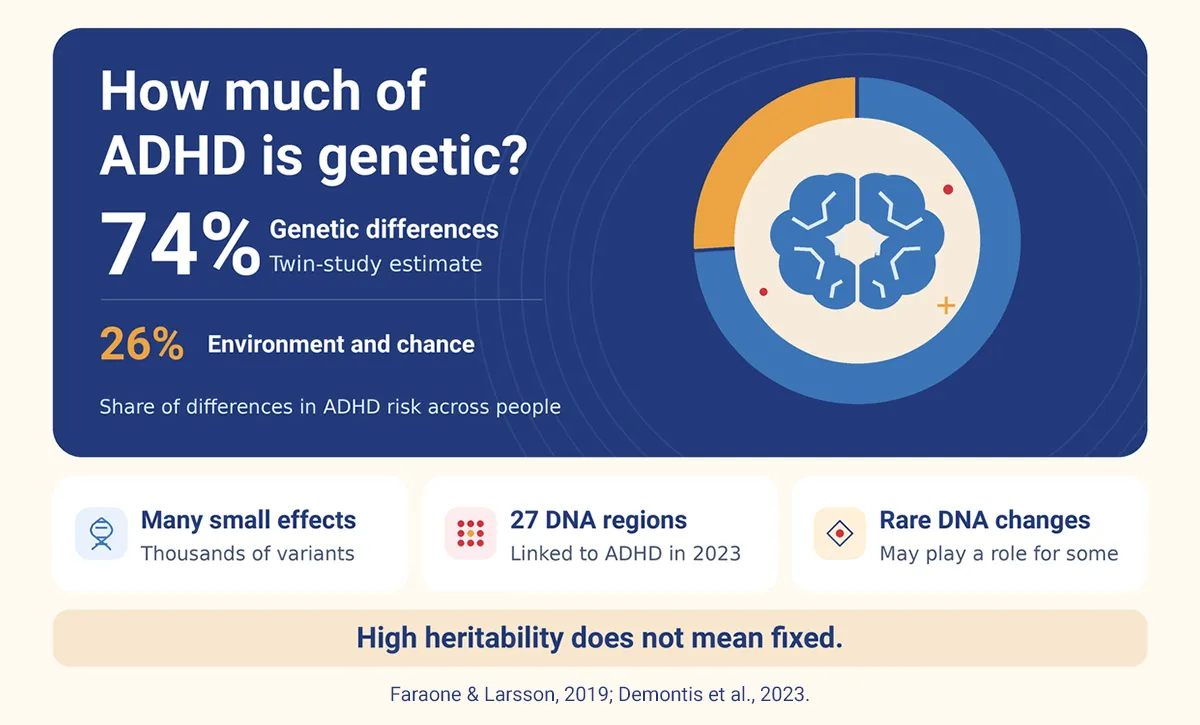
Heritability tells us how much of the difference between people in a group comes from genes. It is not a personal chance. A heritability of 74% does not mean your child has a 74% chance of having ADHD.
There is also a puzzle. Twin studies point to about 74%. But the common DNA variants found so far explain only about 22%. Scientists call this "hidden heritability." It means we have not found all the genetic pieces yet.
Genes matter, but they are not destiny
Having a parent with ADHD raises the odds. It does not seal the outcome. Many children of parents with ADHD never develop it, and some children develop ADHD with no family history at all.
Why? Because the environment also counts. Premature birth, low birth weight, head injury, and exposure to some chemicals or heavy metals can raise the risk. Poor parenting, too much screen time, and eating sugar are not causes. A 2026 clinical review in the Canadian Journal of Psychiatry also tells doctors to focus on risks you can change when they talk to families.
Think of height. Height is highly heritable. Yet a child who gets poor nutrition may not reach their full height. ADHD works in a similar way. Genes load the dice, and daily life changes how the roll lands.
What this looks like in India. A 2024 review found adult ADHD rates in India between 5.48% and 25.7%, depending on the group studied. In a Delhi-NCR survey of 1,665 college students, 14% screened positive. A screening test is not a diagnosis, but the numbers show that many people may go unnoticed. Knowing your family history is a good first step.
How food, sleep, and routine shape ADHD symptoms
Let us be clear. Diet does not cause ADHD, and it does not cure it. But it can change how you feel and function from one day to the next. That matters for focus, mood, and how fast you bounce back after a hard day.
Here is what studies show so far:
Ultra-processed food: A 2025 review in Metabolites reports that meta-analyses link low-quality diets, high in ultra-processed foods, with a higher risk of ADHD in children and adults. Diets rich in fruit, vegetables, whole grains, and fish point the other way. This is a link, not proof of cause.
Omega-3 fats: These fats from fish, walnuts, and flaxseed support brain function. Results from trials are mixed (more on this below).
Iron, zinc, magnesium, and vitamin D: A 2022 review found a clear biological reason to look at these nutrients. But the proof is stronger in observational studies than in clinical trials.
Gut health: Early research ties gut bacteria and inflammation to ADHD. This area is still young.
Simple habits that help many families, even though large trials are still limited:
Eat at regular times so energy does not crash.
Add protein and fiber to breakfast, such as eggs, paneer, sprouts, or dal chilla.
Cut back on packaged snacks, sweet drinks, and deep-fried items.
Keep a steady sleep schedule. Poor sleep makes ADHD symptoms feel worse.
Watch caffeine, especially late in the day.
These steps support recovery after a tiring day or week. They work best as a team with therapy, school or workplace support, and medicine when a doctor advises it.
Why a generic ADHD diet is guesswork
Search online and you will find endless "ADHD diet" lists. Most say the same things: more fish, less sugar, take omega-3. The trouble is that bodies are not the same.
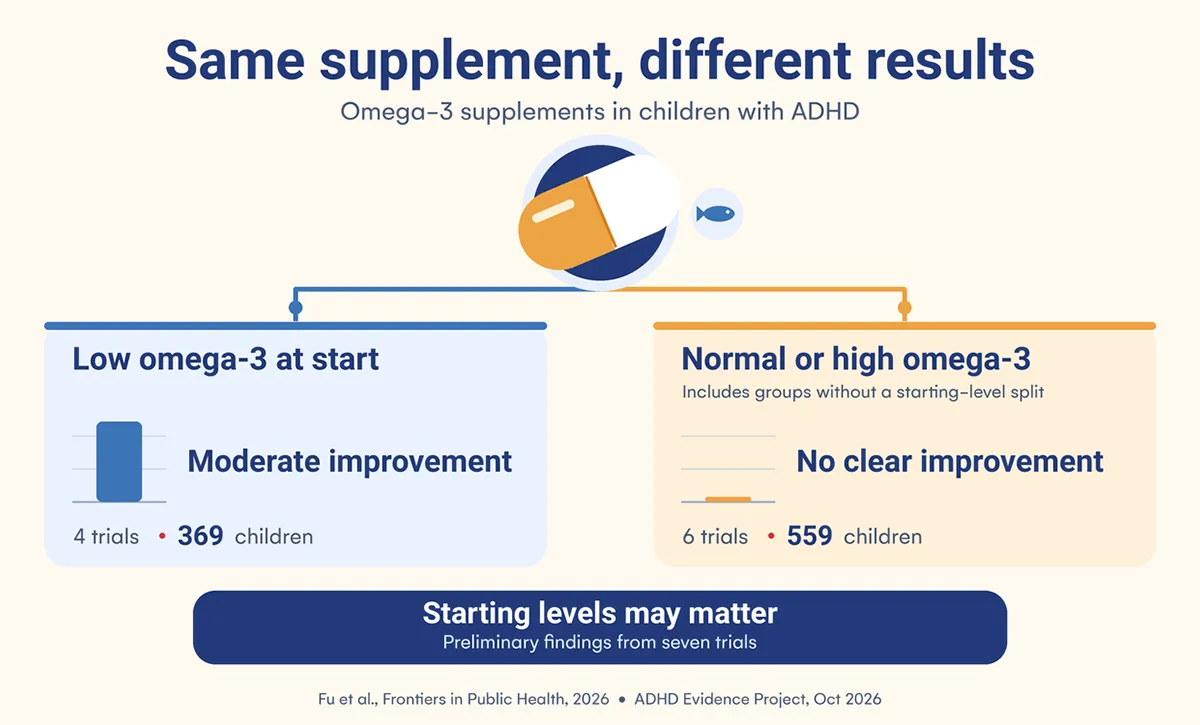
Omega-3 is a good example. In October 2026, a meta-analysis of seven trials with 654 children was summarized by ADHD Evidence. It found only a small gain overall. But the split was striking:
In four trials with 369 children who had low omega-3 levels at the start, supplements gave a moderate improvement.
In six trials with 559 children who had normal or high levels, supplements gave no improvement at all.
So the same supplement helps one child and does nothing for another. The only way to know which group you are in is to measure. Taking it blindly costs money and may give you nothing.
The same goes for strict elimination diets. A 2012 review found that intensive plans, such as cutting all additives, helped only small subgroups. Cutting out whole food groups with no clear reason can also leave a growing child short on nutrients.
How a DNA-based plan makes it more precise
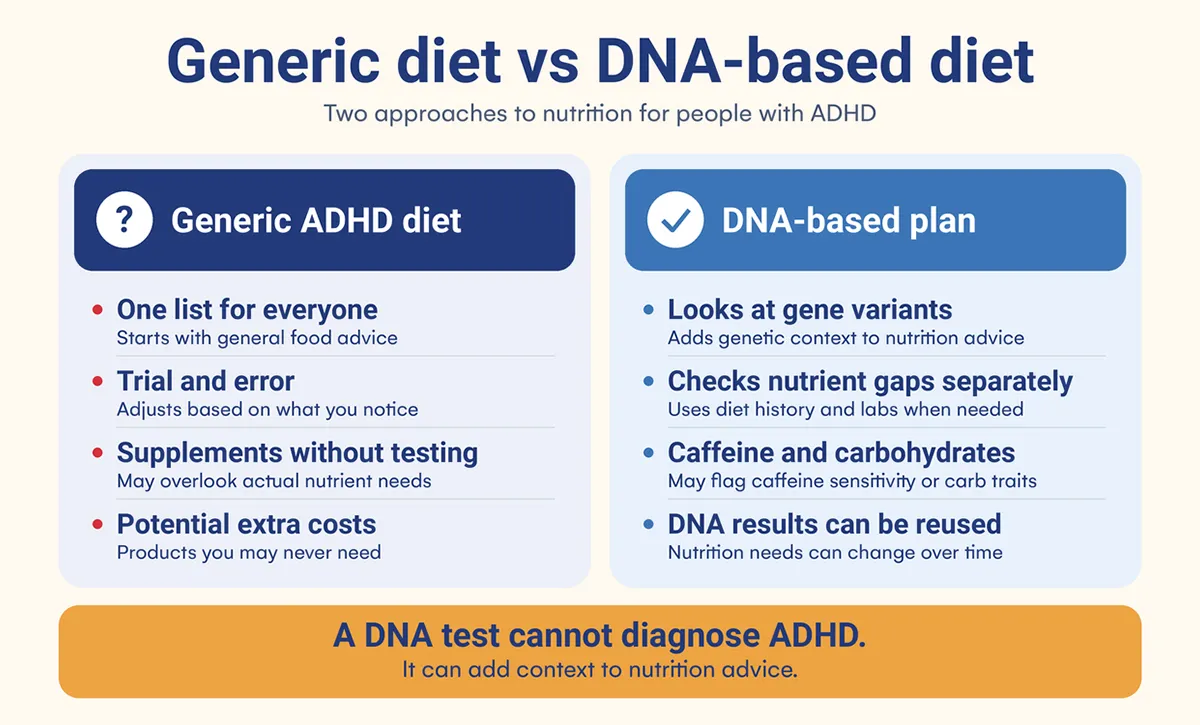
A generic plan says, "Eat this for ADHD." A DNA-based plan asks, "How does your body handle food and nutrients?"
A DNA nutrition test looks at gene variants that affect things like:
How well you turn plant-based fats into the omega-3 your brain uses
How your body uses vitamin D, folate, and B12
How fast you break down caffeine
How you handle carbohydrates and blood sugar
How well you absorb nutrients such as iron
The exact genes vary by test, so always check what your report covers.
This matters for ADHD because small gaps add up. A person who clears caffeine slowly may feel jittery and sleep badly after an afternoon tea. Someone who converts omega-3 poorly may need a direct source like fish or algae oil, while a person with no such gap may not. Combined with blood tests, your DNA report helps you spend your effort and money on what your body actually needs.
There is one more link. Doctors sometimes use gene testing to guide medicine. The 2026 clinical review notes that CYP2D6 testing supports dosing of atomoxetine, an ADHD medicine. It does not support routine testing to pick a stimulant. That is a separate, doctor-led test, and you should not start or change medicine based on any report on your own.
What a DNA test cannot do
We want to be honest, because trust matters more than a sale:
It cannot diagnose ADHD. The same 2026 review states there is no diagnostic genetic test for ADHD. Diagnosis comes from a clinician who looks at symptoms, daily function, development, and family history.
It cannot predict your child's ADHD. In a 2024 study of 576 adults with ADHD and 530 controls, adding a polygenic score to symptom scales improved accuracy by only about 0.6 percentage points.
It is not a cure. It guides nutrition and lifestyle choices. It sits beside, not instead of, medical care.
If a company claims a DNA test can "detect ADHD," be careful.
A simple plan you can start this week
Talk to a doctor if you suspect ADHD. Ask for a full clinical assessment.
Map your family history. Ask relatives about attention, school, and work struggles. Share notes with your doctor.
Check your basics. Ask your doctor about blood tests for iron, vitamin D, and B12 before you buy supplements.
Fix the easy wins. Set regular meals, a steady bedtime, and a caffeine cut-off.
Personalize your plan. Use a DNA nutrition test to see which nutrient and food choices fit your body.
Review every few months. Track focus, mood, sleep, and energy in a simple notebook.
Take the test once, then use it for life
Your DNA stays the same for your whole life. That means one test gives you a result you can return to as your needs change, whether you are a school-going child, a working adult, or a parent planning meals for the family.
If ADHD runs in your family, you cannot change your genes. You can change what you do with that knowledge. A Lifecode DNA nutrition test turns "eat healthy" into steps built around your body.
Resources
ADHD Evidence, New research on omega-3s and ADHD (Fu et al., Frontiers), Oct 26, 2026.
Dietary influences in ADHD: narrative review. Functional Food Science, 2022.
Prevalence of adult ADHD in India: systematic review and Delhi-NCR study. Soc Psychiatry Psychiatr Epidemiol. Pubmed
Medical disclaimer:
This article is for education only. It is not medical advice and does not diagnose or treat any condition. Talk to a qualified doctor before you change your diet, start supplements, or change any medicine.