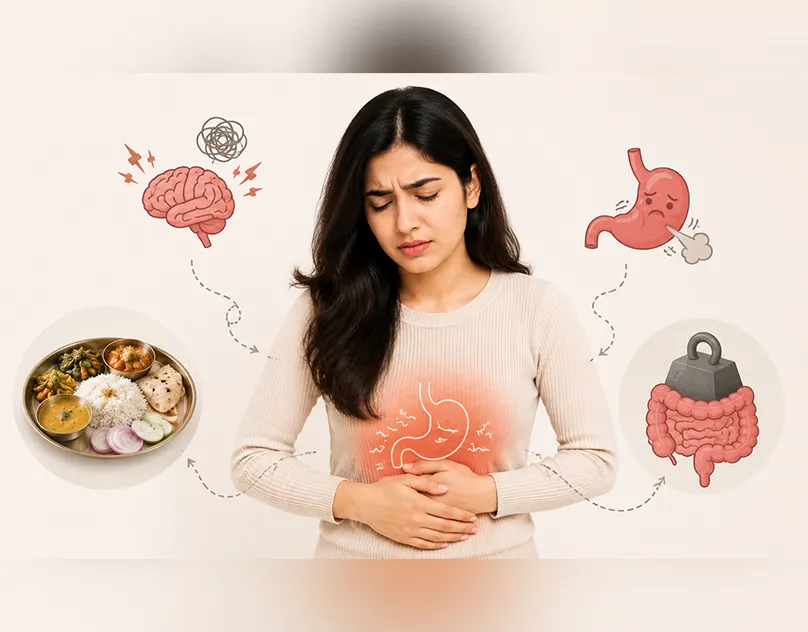
Have you ever finished dinner, glanced in the mirror, and noticed your face looks fuller than usual? Or found your rings feel uncomfortably tight barely an hour after eating? If this sounds familiar, you’re far from alone. Sudden post-meal puffiness is one of the most common (and most confusing) things people notice about their bodies.
It’s tempting to blame the meal itself, saying “I had too much namak” or “that curry was too salty.” But the real picture is more layered. Puffiness after eating is usually the result of several things happening at once inside your body: your sodium intake, your stress levels, and, as research increasingly shows, your genetics. It’s also worth remembering that water retention and facial puffiness can have other causes entirely, including sinusitis, allergies, hormonal changes (such as those linked to your menstrual cycle, pregnancy, or thyroid function), certain medications, and prolonged sitting or standing. If your puffiness doesn’t follow the usual pattern of easing within a day, it may be worth looking beyond diet alone.
Understanding why this happens is the first step to managing it, and to knowing when it’s simply your body doing its job versus when it’s worth a closer look.
The Science of Sudden Puffiness
What you’re seeing in the mirror has a name: water retention, medically referred to as edema when it’s more pronounced. Your body is constantly working to keep the concentration of sodium and water in your bloodstream within a narrow, tightly regulated range.
Here’s the mechanism in simple terms:
You eat a meal high in sodium.
Sodium levels in your blood rise.
To dilute that sodium and restore balance, your kidneys and hormonal system signal your body to hold onto extra water rather than eliminate it.
That extra fluid doesn’t stay neatly in your bloodstream. Some of it moves into the spaces between your cells (the interstitial tissue), especially in areas with looser tissue like your face, hands, ankles, and feet.
In most healthy people, this is a normal, temporary regulatory response. The swelling you notice is your body prioritizing chemical balance over comfort, and it usually resolves within a day as your kidneys gradually excrete the excess sodium and water.
How Much Salt Are We Actually Eating?
This is where the picture looks different depending on where you live, and it’s a meaningful gap in a lot of health content written for a global audience.
Much of the popular writing on this topic cites U.S. data, where the CDC has found that roughly 89% of American adults exceed the recommended sodium limit. But if you’re reading this in India, your risk factors look somewhat different, and if anything, more pronounced.
According to India’s National NCD Monitoring Survey (NNMS), conducted by ICMR-NCDIR (Indian Council of Medical Research – National Centre for Disease Informatics and Research) under India’s Ministry of Health & Family Welfare, the average Indian adult consumes about 8 grams of salt per day — men slightly more (8.9g) than women (7.1g). This is measured against the World Health Organization’s recommended limit of just 5 grams per day. A separate 24-hour urine study of 1,395 people across Delhi, Haryana, and Andhra Pradesh, published in the Journal of the American Heart Association, found adjusted salt intake estimates of 9.45–10.41 grams a day in these communities — roughly double the WHO limit. Much of this comes from salt added during cooking, papads, pickles, and processed or restaurant food — patterns that are somewhat different from the packaged-food-driven sodium intake seen in Western diets.
In short: if you regularly notice puffiness after meals, the odds that “too much salt” is a contributing factor are, statistically, higher for an Indian adult than for the global average.
How Stress Makes Salt Worse
Salt alone doesn’t tell the whole story. Emotional and physical stress acts as a hidden multiplier on this whole process.
When you’re under stress, whether it’s a tense workday, poor sleep, an argument, or even sitting in heavy traffic, your body activates its “fight-or-flight” response and releases the hormone cortisol. Cortisol’s job is to prepare your body for a perceived threat, and one of the ways it does this is by influencing your kidneys.
Here’s the chain reaction:
Cortisol tells your kidneys to conserve sodium. Rather than excreting sodium normally, your kidneys are signaled to hold onto more of it.
Retained sodium means retained water. Wherever sodium goes, water follows, to maintain the right concentration.
The combined effect compounds. If you eat a salty meal while under stress, the cortisol response and the sodium load work together, producing more noticeable puffiness than either factor would cause alone, even on an otherwise identical day.
This is part of why the same meal can leave you looking and feeling different depending on how your day has gone. It’s rarely about the food in isolation.
Why Some People Are More Sensitive Than Others
You may have noticed that some people can eat a heavily salted meal with no visible effect, while others swell up almost immediately. This variation is well documented in research, and a meaningful part of it appears to be genetic.
Research in genetics and endocrinology has identified variations in genes related to the Renin-Angiotensin-Aldosterone System (RAAS), the hormonal system that regulates blood pressure and fluid balance, that are associated with differences in “salt sensitivity.” A 2022 study in the journal Hypertension linked specific variants in genes such as AGT, SGK1, and ESR2 to greater blood-pressure and fluid-retention responses to sodium. Similarly, genes involved in cortisol metabolism can influence how strongly your body’s stress response affects your fluid balance.
It’s worth being precise about what this research does and doesn’t tell us: salt-sensitivity genetics is an active, evolving area of study, not a fully settled science. Findings are associative, not diagnostic, and are not yet used in routine clinical practice. In fact, a 2016 systematic meta-analysis of three commonly studied RAAS genes (ACE, AGT, and CYP11B2) found no consistent association with salt sensitivity across the studies reviewed, underscoring how mixed the evidence still is. Genetic variants can indicate a predisposition. They are one contributing factor among several (which also include age, kidney function, existing health conditions, and overall diet), not a standalone diagnosis or a guarantee of how your body will behave.
This is where genetic testing can offer a useful, personalized layer of insight, not as a replacement for lifestyle basics, but as an additional data point to help you understand your own patterns.
Simple, Evidence-Based Ways to Reduce Puffiness
If you’re dealing with everyday, temporary swelling (not a symptom you’re worried is medical, see the note below), a few gentle habits can help your body restore its natural balance faster:
Drink water steadily through the day. It seems counterintuitive, but adequate hydration signals to your body that it’s safe to release retained fluid, rather than hold onto it defensively.
Include potassium-rich foods. Potassium helps your body manage its sodium-to-potassium ratio more efficiently. Good Indian-diet-friendly options include bananas, coconut water, spinach and other leafy greens, sweet potatoes, and pulses like moong and chana.
Move gently after meals. A short walk or light stretching engages muscle contractions that help push fluid out of tissues and back into circulation through your lymphatic system.
Practice slow, deep breathing. Deliberately slowing your breath activates your parasympathetic nervous system, the “rest and digest” counterpart to fight-or-flight, which helps bring cortisol levels back down.
Moderate, don’t eliminate, salt. Rather than cutting salt entirely, aim to stay closer to the WHO’s 5g/day guideline by cutting back on added salt at the table, pickles, and packaged snacks, while still allowing your body the sodium it needs to function.
Where Genetic Testing Fits In
Because salt sensitivity and stress response vary so much from person to person, generic advice (“just drink more water” or “cut salt”) doesn’t land the same way for everyone. Consumer genetic testing for traits like salt sensitivity is a relatively new field, and its clinical utility is still debated among researchers. These tests can highlight predispositions but don’t yet predict outcomes with certainty. If you’re curious about your own genetic patterns, testing can be one additional data point, but it should never replace the fundamentals above or a doctor’s evaluation of unexplained swelling.
Disclosure: Lifecode’s analyzes variants linked to sodium sensitivity and stress-hormone metabolism. As with all consumer genetic panels, results should be interpreted as exploratory information, not a diagnosis, and discussed with a healthcare provider.
If you’re curious whether your own genetic profile plays a role in how your body responds to salt and stress, you can learn more and order a kit at Lifecode.life.