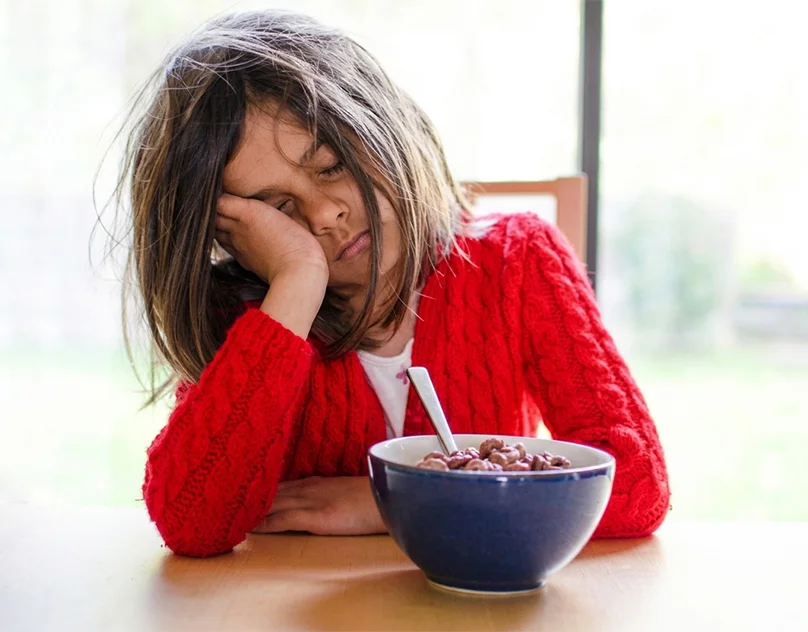
It’s 7:15am. You put your child to bed at 9:30 last night. That’s nearly ten hours of sleep more than most adults get on a weeknight. And yet here they are at breakfast, slumped over their bowl; eyes glazed, barely present. You’ve tried earlier bedtimes, no-screens policies, blackout curtains, even melatonin gummies.
Nothing works. And the question quietly haunting you is this: is child always tired in morning genetics the reason could something in their DNA be behind this?
The answer, increasingly, is yes.
It's Not a Routine Problem. It's a Biology Problem.
Before you try another sleep hygiene checklist, consider this: not every child’s internal clock runs on the same schedule. Circadian rhythms, the biological clocks that govern sleep, wakefulness, hunger, and alertness are not identical across children. And a growing body of research confirms that child sleep genetics India and globally plays a major role in setting those clocks.
The key players are genes like CLOCK and PER3, which form the molecular backbone of your child’s circadian system. Variants in the CLOCK gene can cause a child’s internal clock to run late, which means the body doesn’t signal sleepiness until well past a conventional bedtime, regardless of what time you turn the lights off. This is not defiant. It is CLOCK gene child sleep biology in action.
What Is a Chronotype and Why Your Child Has One
The term chronotype child refers to a child’s natural, genetically influenced preference for the timing of sleep and wakefulness. Some children are wired to wind down by 8pm and rise early; others have a biological clock that doesn’t begin its descent into sleep until 10 or 11pm.
A chronotype child who runs late isn’t choosing to stay awake. Their melatonin rises later. Their core body temperature drops later. Their brain enters deep sleep later. Put them to bed at 9pm and their body simply isn’t ready, which means they may lie awake for an hour, or slide into light, broken sleep that doesn’t restore.
This mismatch is the most overlooked answer to why child tired after sleep even after a seemingly full night. It’s not the hours that are lacking. It’s alignment.
Sleep Debt Without Realising It
Here’s how the cycle plays out in real life.
A child with a late-running genetic sleep schedule child profile is put to bed at 9:30pm because school demands a 6:30am wake-up. Their biology, however, doesn’t prepare for deep sleep until 11pm. The first hour and a half in bed is lost to restlessness or shallow sleep. Deep, restorative sleep doesn’t arrive until close to midnight, and the alarm cuts it short at 6:30.
Nine hours in bed. Perhaps five to six hours of genuine sleep. And a child who drags themselves to school looks exhausted.
This is what researchers describe as child always tired in morning genetics, a pattern driven not by bad habits but by a biological clock running on a different schedule than the one society demands.
The Science Behind It: CLOCK and PER3
The CLOCK gene produces a protein that is central to regulating the 24-hour circadian cycle. Certain variants studied across multiple populations including South Asian cohorts are associated with delayed sleep phase tendencies. Research into CLOCK gene child sleep patterns shows that children carrying these variants have measurably later melatonin peaks and later optimal sleep windows.
The PER3 gene works in concert with CLOCK, influencing sleep pressure and the depth of slow-wave sleep. Variants in PER3 can determine not just when a child wants to sleep, but how much slow-wave, restorative sleep they generate once asleep which directly connects to why child tired after sleep even with adequate time in bed.
Studies examining child sleep genetics India specifically are beginning to reveal that population-level gene frequencies may differ from Western cohorts, which is a critical reason why blanket sleep advice from global sources may not apply to every Indian child equally. A child’s sleep tendencies are personal shaped by their unique DNA, not a population average
Working With the Rhythm, Not Against It
Once you understand that your child’s sleep tendencies have a genetic sleep schedule child basis, the approach shifts completely from correcting behaviour to accommodating biology.
Observe natural wind-down cues. Notice when your child genuinely begins to slow down quieter, less stimulation-seeking, eyes softening. That is their biological sleep onset window. It may be 9pm or it may be 10:30pm. Neither is wrong.
Stop fixating on the clock, start watching the child. A child who falls asleep naturally at 10pm and sleeps deeply until 7am may be far more rested than one who lies in bed from 8:30pm unable to sleep. Quality and timing are as important as hours.
Use weekends as a window. Allow your child to wake naturally at least once a week when possible. Their spontaneous wake time tells you when their sleep cycle has genuinely completed giving you a data point for a better bedtime.
Reduce evening light exposure. Bright light, especially from screens, delays melatonin release further worsening the situation for a chronotype child who already runs late. Dim the home and reduce screen exposure after sunset. Small changes here can shift sleep onset meaningfully over time.
Consider a conversation with school. Urban schools across India are slowly becoming more aware of chronotype variability in children. While structural change is rarely immediate, a teacher who understands that a child’s tiredness is biological not attitudinal — can make a meaningful difference in how that child is treated.
If child always tired in morning genetics is a loop you’ve been stuck in, the most important thing to understand is this: you are not failing, and your child is not being difficult. Their body is running on a clock that was set by their genes and when that clock is misaligned with the world’s schedule, tiredness is the inevitable result.
Understanding the role of child sleep genetics India and globally means moving from frustration to insight. From “why won’t they just sleep?” to “what does their body actually need?” That is where change becomes possible.
Understand Your Child's Natural Sleep Rhythm. Explore the Children's Health Blueprint.
The Children’s Health Blueprint from LifeCode gives you personalized insight into your child’s chronotype tendencies, CLOCK and PER3 gene variants, and practical guidance for aligning their environment with their biology so they can finally wake up feeling like themselves.