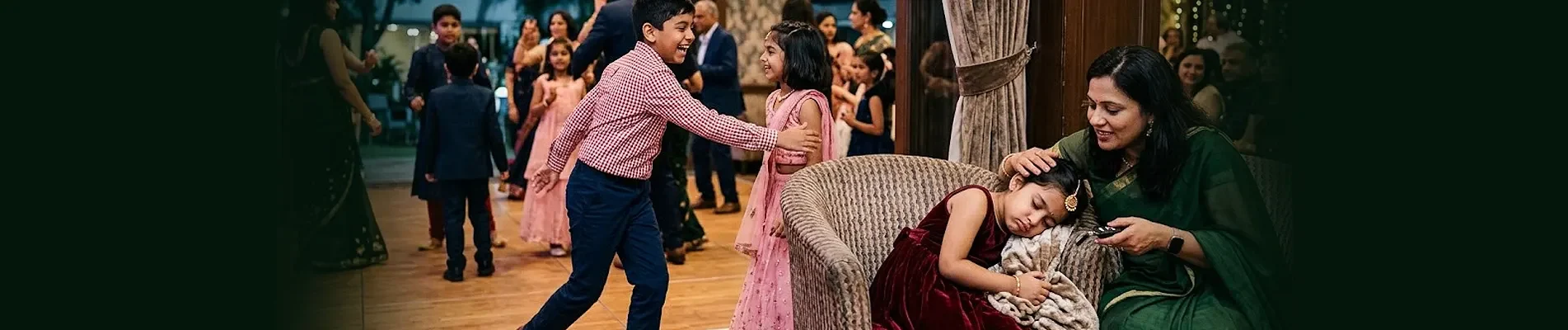
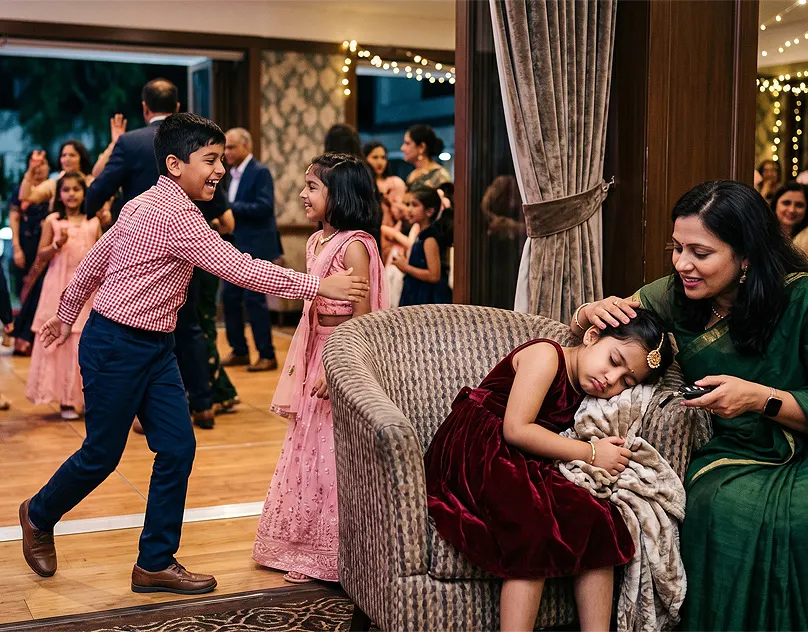
It is 10:00 PM at a bustling Sunday family gathering at the local club. The music is loud, the lights are bright, and the room is a whirlwind of conversation. On the dance floor, your eldest child is still going strong, laughing and chasing cousins with boundless energy. Meanwhile, your youngest has been quietly retreating since hour two first slipping behind the curtains, then curling up on a chair, and finally begging to go home.
You see the exact same pattern play out during the annual international school concert, crowded festive weddings, and even at busy holiday resorts with the extended family.
As a parent, it is easy to wonder: Why does the exact same environment fill one child with life while leaving another completely drained?
Often, well-meaning relatives label the retreating child as “shy” or assume they are just being difficult. But the truth has nothing to do with behaviour, attitude, or social anxiety. Instead, it comes down to a child overwhelmed in crowds genetic blueprint. Your children are simply operating on entirely different genetic processing architectures.
It Is Not Personality, It Is Neurochemistry
When we see a child struggle in a bustling room, our minds often jump to behavioural or psychological explanations. However, when looking at a social overwhelm child neurological response, we are looking at how a young brain processes chemistry under high stimulation.
Every laugh, bright light, loud song, and unexpected bump in a crowded room represents sensory data. How a child’s brain handles this data depends heavily on two critical chemical messengers: dopamine (the reward and alertness chemical) and serotonin (the mood and stabilization chemical).
When a child experiences child sensory overwhelm crowds India style, events are naturally larger, louder, and highly vibrant as their internal filtration system is working at absolute capacity. Neither profile is flawed; they are just wired differently to handle the exact same environment
The Genetic Engines: Meeting COMT and SERT
To understand why one child leaves an event energized while another leaves depleted, we have to look under the hood at their genetic processing speed. Two specific genes play a massive role in this daily family dynamic.
1 .The COMT Gene: The Dopamine Regulator
The COMT gene is responsible for clearing dopamine out of the prefrontal cortex of the area of the brain that handles planning, focus, and sensory integration.
The Fast Clearers: Some children possess a highly efficient COMT variant that clears dopamine rapidly. In a quiet room, they might feel under-stimulated or bored. When dropped into a massive, noisy event, the flood of sensory input spikes their dopamine to the perfect level. They feel alive, focused, and energized.
The Slow Clearers: Other children have a variant that clears dopamine much more slowly. In quiet settings, their dopamine levels are optimal. But when they enter a loud festive gathering, the avalanche of sensory data causes dopamine to pile up. This leads to the COMT gene social sensitivity child profile. The brain becomes flooded, turning what should be a fun event into a state of neurological overdrive.
2.The SERT Gene: The Serotonin Processor
The SERT gene manages the transport of serotonin, which helps regulate how the brain responds to stress and environmental stimuli.
Children with specific variations in their serotonin transport system experience a heightened sensitivity to their surroundings. When exploring why child hates crowds’ genetics provide the answer: their nervous system is naturally designed to register every single sound, smell, and micro-interaction with intense clarity. They aren’t choosing to be overwhelmed; their biology is literally absorbing the room at a higher volume.
The Neurodiversity Perspective
This distinct mix of genetic traits highlights the beautiful spectrum of neurodiversity genetics child India profiles. Experiencing sensory processing tendencies that lean toward high sensitivity is a normal, healthy biological variation not a condition to be fixed.
The Biological Reality vs. Clinical Labels
When a child hits their limit at a social event, it is vital to frame their experience correctly. This is not a clinical disorder, nor is it a behavioural deficit. It reflects their unique genetic architecture.
By recognizing the social overwhelm child neurological foundation of these behaviours, parents can move away from frustration and move toward tailored support.
A Parent’s Action Plan: Preparation and Recovery
If you have a child who matches the COMT gene social sensitivity child profile, you do not need to avoid family celebrations or school milestones entirely. Instead, you can use these practical, biology-backed strategies to help them navigate high-stimulation days without crashing before the next school week begins.
Proactive Event Preparation
The Pre-Event Buffer: On the day of a major social gathering, keep the morning incredibly low-key. Avoid scheduling back-to-back activities. Let their nervous system start the event with a fully charged battery.
Pre-Mapping the Venue: When arriving at a crowded venue, scout out a “quiet zone” together. It could be a calm hallway, an empty terrace, or even a parked car. Let your child know: “If the room feels too loud, this is our safe spot where we can come sit together for ten minutes.”
Set Clear Exit Expectations: Give your child a sense of control by agreeing on a realistic timeline or a subtle signal they can give you when their battery hits 5%.
Structuring Post-Event Recovery
The Decompression Chamber: The ride home from a high-stimulation environment should be a sensory reset. Keep the car radio off, dim the dashboard lights, and avoid asking a barrage of questions about how the event went.
Protect the Next Day’s Routine: If a major event occurs over the weekend, ensure the following day is entirely free of social obligations. A child overwhelmed in crowds genetics blueprint requires extra time to clear residual neurochemicals from their system so they can start the school week focused and relaxed.
Beyond the Surface: Looking at the Blueprint
Every child comes with an individual manual written into their DNA. Understanding whether your child has a fast or slow neurochemical processing system takes the guesswork out of parenting. It transforms how you view their behaviours, allowing you to advocate for their needs rather than pushing them past their natural biological boundaries.
Instead of wondering why child hates crowds’ genetics screening offers a clear look into your child’s unique biological makeup. Understanding the intersection of child sensory overwhelm crowds India factors and innate biology gives you the tools to help them thrive in a fast-paced world.