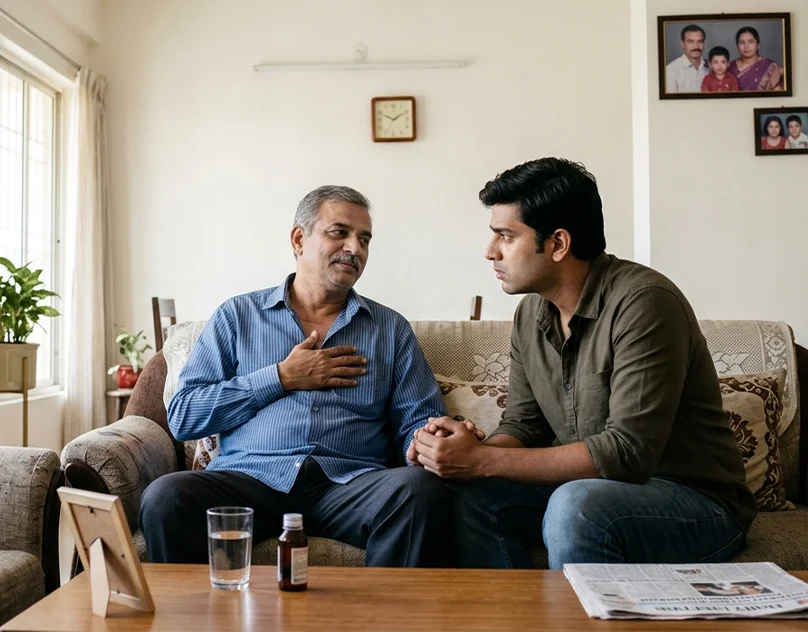
The number is likely tucked away somewhere in the back of your mind. 54. Or maybe it is 51, or 48. It is the age your father was when the phone call came the one that altered your family’s trajectory in an afternoon.
When you are a high-stress professional navigating your late 30s, you are used to managing numbers: quarterly targets, investment portfolios, and flight departure times. But that specific age, the one associated with your father’s first cardiovascular event, often lingers as an unspoken baseline.
This article is not about fear. It is not a countdown timer, nor is it a grim prediction of an inevitable future. Instead, this is about cardiovascular foresight India professionals can leverage today. It is about shifting from a mindset of passive waiting to active, strategic foresight.
If your father had a cardiac event in his early 50s, and you are sitting at your desk today at 38, the question you should be asking is not “Will this happen to me?” The question you need to ask is: “What specific heritable tendencies did I inherit, and how do I map them before they map me?”
The Illusion of "My Cholesterol is Fine"
A common script plays out in executive health checkups across India. You sit down with your report, see your LDL and HDL cholesterol levels sitting comfortably within the standard reference ranges, and breathe a sigh of relief. You think, “My cholesterol is fine now, so I must have bypassed the family history.”
Unfortunately, standard blood panels only provide a snapshot of your current metabolic state; they do not reveal the underlying blueprint. Saying your current numbers are fine is not the same as saying you have no inherited tendencies.
When looking at a family history heart disease what should I do genetics becomes the crucial tool to bridge the gap between current appearance and future clarity. Traditional blood tests look at the smoke; genetic profiling looks at the structural integrity of the building.
For high-stress professionals in India, the traditional biomarkers we rely on often fail to tell the whole story. Incidents of hereditary heart disease India wide show that cardiovascular events frequently occur in individuals who deemed themselves “perfectly healthy” based on standard annual physicals. Your current lifestyle and diet are highly important, but they interact directly with a baseline genetic template that you inherited.
Decoding Your Blueprint: APOE, PCSK9, and NOS3
To practice true cardiovascular foresight India requires us to look at the specific genetic markers tha
t dictate how our bodies process lipids, manage inflammation, and regulate blood flow. By utilizing a genetic test family heart history India professionals can look past generalities and focus on precise molecular pathways.
Here are three critical markers that define your inherited cardiovascular tendencies:
The APOE Gene (Apolipoprotein E)
The APOE gene plays a monumental role in how your body metabolizes lipids and clears cholesterol from your bloodstream. Certain variations of this gene can alter how your body responds to dietary fats and stress. Understanding your APOE family history genetics helps clarify whether your body clears lipids efficiently or if it tends to retain them, giving you a clearer picture of your innate lipid processing.
The PCSK9 Gene
This gene regulates the number of receptors on your liver cells that clear LDL (“bad”) cholesterol from the blood. Variations in the PCSK9 gene can lead to fewer receptors, meaning LDL stays in circulation longer, even if your diet is pristine. Knowing your status within the PCSK9 page allows for highly targeted lifestyle and dietary personalization.
The NOS3 Gene (Nitric Oxide Synthase 3)
NOS3 is responsible for generating nitric oxide, a compound that allows your blood vessels to relax, dilate, and maintain healthy blood pressure. Under high-stress environments common among modern professionals, a variation in NOS3 can mean your blood vessels are less resilient to cortisol and adrenaline spikes, impacting vascular health over time.
Instead of wondering about general risks, exploring these markers through a dedicated Cardiovascular cluster panel gives you actionable data long before any clinical event takes place.
Why Family History is a Signal, Not a Destiny
It is vital to distinguish between a heritable tendency and a clinical diagnosis. Having a parental history means you carry the genetic library of your ancestors, but it does not mean your health outcomes are set in stone.
Foresight Over Fear: Your genes write the baseline code, but your daily choices, environment, and targeted interventions write the program that runs on it.
When addressing family history heart disease what should I do genetics serves as an early warning system. It moves you away from generic advice like “eat less fat and exercise more” toward specific strategies tailored to your metabolic architecture. For instance, someone with a specific APOE variant might need to monitor saturated fats much more strictly than someone with a NOS3 variation, who might need to focus primarily on stress mitigation and nitric oxide-boosting protocols.
Investing in a genetic test family heart history India allows you to build a protective wall around your health. It shifts the narrative from worrying about the age your father was when he fell ill, to confidently optimizing your own longevity.
Actionable Foresight: Your Next Steps at 38
If you are ready to move away from the anxiety of the unknown and embrace data-driven wellness, here is how you can apply preventive cardiology genetics India protocols to your life today:
Acknowledge the Signal: Stop treating your father’s health history as an isolated incident or an avoided baseline. Recognize it as useful data.
Look Beyond the Standard Lipid Panel: The next time you get blood work done, remember that standard metrics do not cancel out inherited genetic tendencies.
Map Your Markers: Look into comprehensive genetic profiling that analyzes key clusters like APOE, PCSK9, and NOS3 to understand how your vascular system handles stress and lipids.
Tailor Your Environment: Use your genetic insights to customize your sleep, stress management, and nutrition protocols to match what your body uniquely requires.
Rewriting the Narrative
You do not have to live with a vague, lingering question mark about what your health looks like two decades from now. The number 54 does not have to be a shadow that follows you through your career.
By choosing to explore your family history heart disease what should I do genetics turns a family medical history into a highly personalized playbook for vitality. With the right data, you can build an environment that supports your genetic baseline, ensuring that your peak professional years are matched by your peak physical years.